Showing posts with label Ministry. Show all posts

December 05, 2013

Boxing Lament, Creating Playlists, and Backwards Parties: Spiritual Practices for a Busy Generation

I was talking with a clergy colleague/friend recently about an intergenerational study she is putting together for her congregation about spiritual disciplines.  We talks a bit about the different resources she is (and could) pull from.  There are a number of books about spiritual disciplines published.  I had never heard the term “spiritual discipline” until I was in college.  I was introduced to the term and the concept through Richard Foster’s Celebration of DisciplineMy family and church community had certainly practiced spiritual disciplines (some better than others), but I had never seen them all laid out and talked about as a whole. 
51m rLUW5kL._BO2,204,203,200_PIsitb-sticker-arrow-click,TopRight,35,-76_AA278_PIkin4,BottomRight,-66,22_AA300_SH20_OU01_In the years since, I have read a number of such books at different points in my life.  Each has a slightly different tone and focus.  Most recently I read Who’s Got Time: Spirituality for a Busy Generation by Teri Peterson and Amy FettermanIt is one of the newest titles in the Young Clergy Woman Project imprint with Chalice Press.  Peterson and Fetterman are both youngish pastors and they wrote this primarily for people in their generation.  People who grew up with computers.  People who grew up moving frequently and far from extended family.  People who are marrying later and later or not marrying at all.  People who struggle to find work and if they do expect to change jobs regularly for the rest of their life.
Peterson and Fetterman do a great job of suggesting ways to practice spiritual disciplines (both classic and new) in the busy, hyper-connected life most of us live.  I really appreciated their practicality and creativity.  As much as a I respect Foster’s work, Celebration of Discipline doesn’t include a chapter on social media. 
Here’s a sampling of some of the ideas that I found interesting (they cover more traditional disciplines, like fasting, too).  Chapter two is called “In the Body,” and it explores “ways we can exercise our spirits as we live in flesh and bone.”  One of their suggestions is to incorporate a piece of scripture into a boxing (or kickboxing?) routine.  They say “Amy’s personal favorite combo includes Psalm 61:1 and goes like this: Hear *jab* my *jab* cry *right hook* O *left hook* God *backfist*.”  I may or may not actually try this one myself, but a physical lament sounds awesome!
Chapter four is all about using music in the life of faith.  One of my favorite ideas from the chapter I already shared on the blog—making playlists.  They suggest peace and righteous anger playlists.  I made a wait. hope. expect. playlist that helps me to wait with hope during this period of my life.
They also have a chapter on rituals that I found inspiring.  They wonder “How do we organize our hopes, dreams, fears, realities, loves, losses, and find a sense of the Holy in the midst of them? How do we mark these life events that don’t have rituals already attached to them the way marriage or kids do?…We believe there is a way to create ritual that makes meaning out of the lives we live now, as twenty-first–century young adults” (ch. 5).  One of the examples they give is a “backwards party” when one of their friends was moving away.  They started by saying goodbye, ate dessert, then dinner, and ended with saying hello.  It was a ritual that helped this group of friends to transition to a new phase of their friendship.  I haven’t started any new rituals yet, but I’m thinking of opportunities.
There are lots more ideas in the book, and I would encourage you to check it out for yourself if you are looking to grow in your spiritual walk.  I would add a note that I am a bit more conservative in theology than the authors, and a few ideas I’m not sure I’d be comfortable trying.  But that doesn’t mean they don’t have lots of good ideas and true thoughts.  

November 28, 2013

Thanksgiving Standing Stones 2013

I have a tradition at Thanksgiving to make a list of “standing stones”—the things that I look back on in the year and say “look at what God has done.”  Last year was full of big and joyful milestones, like being ordained.  This year is a bit more subdued, especially the last few months.  But still, I am thankful for the opportunities and gifts God has given me this year. 
IMG_0882

Travelling to the UK for three weeks in January.  I got to experience the church and culture, which despite common stereotypes, caused me to say look what God is doing!


IMG_0068

Performing my first baptisms of two young people that came to the United States as refugees.  Their faith is rich, deep, and growing as they have faced many difficulties in their short lives.  I am thankful that I got to be a small part of their stories.


IMG_1440

I got to go on lots of short camping trips this Spring, Summer, and Fall.  It was wonderful to spend lots of time outside hiking, eating, reading, watching birds, and enjoying the wonders of God’s creation.  (If you’re curious, the photo is from May in Tahquamenon State Park Rivermouth Semi-Modern Campground.)
IMG_2653

My pastoral residency at Church of the Servant, which ended at the end of July.  This one is definitely bittersweet—I really miss being a pastor there, but I am so overwhelmingly grateful for the two years I got to spend there learning, loving, preaching, visiting, baptizing, welcoming, and being loved.


IMG_3750

The two weeks I got to spend in Colorado and Wyoming during October.  I spent time with Mary and Jared (my sister and brother-in-law), and my friend Allison and her family.  I saw a whole new part of God’s creation—an exhilarating part.  I even climbed mountains, sort of.  At least I went on a short hike above the treeline.  
7935228564_f035829e3a_o

Having a spiritual director who helps me each month to see what God is doing in my life.  I am thankful for her support and encouragement that God is working in me, even when I can’t see exactly what God is doing yet.
733829_610479004214_187675179_n

I am so thankful for the gift of friends who have listened to me, waited with me, encouraged me, prayed for me, discerned with me, and loved me.  I really would not have made it through these years without them.


“Save us, Lord our God, and gather us from the nations, that we may give thanks to your holy name and glory in your praise.”
-- Psalm 106:47

Photo of spiritual direction feet by Michelle Kroll, used under a Creative Commons License.  All other photos are my own.

November 26, 2013

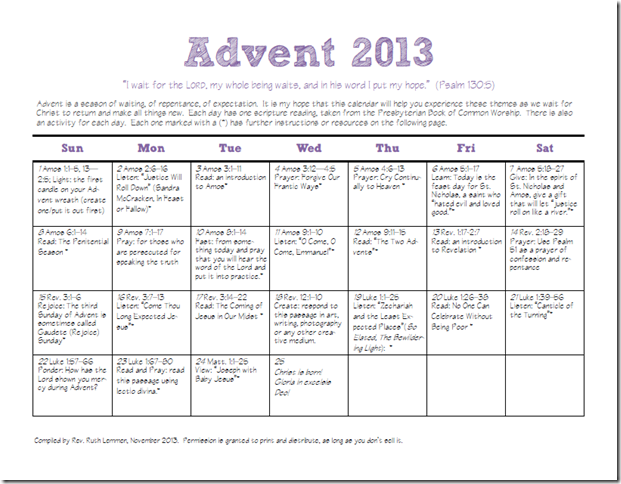
Advent Calendar Printable

This coming Sunday, December 1, is the first week of Advent.  Advent might be my favorite season of the church year—you can look forward to a number of Advent themed posts in the coming weeks.  It is a time of expectant waiting.
A few weeks ago, my sister wrote to me and asked if I had any suggestions for Advent calendars.  She wanted to make one, but wasn’t sure of what activities to put on it that a) weren’t geared for kids and b) had some spiritual significance.  I did a tiny bit of internet browsing and couldn’t come up with anything that was workable, either. So I decided to create my own.  I assigned one scripture for each day and then an activity.  The activities vary and are at least loosely connected to the scripture.  Some samples: listening to “Zechariah and the Least Expected Places,” using Psalm 51 as a prayer of confession, choosing something joyful to do, and reading a passage with lectio divina (instructions included).  Although this isn’t written specifically with children in mind, I think you could easily use it with older children and teenagers.   advent calendar
I enjoyed putting this together, and I’m looking forward to using it myself.  If you are looking for something to guide your reflection during Advent and help you engage the themes of Advent—and the God who came in the flesh and will come again—please feel free to use it, too.  It is available as a free printable.  You are free to print and distribute this, but I do ask that you don’t sell it—I’m making it available for free and would like to keep it that way.  Have a blessed Advent!  

November 24, 2013

Sunday Afternoon Prayer: Confession for Christ the King

This morning I was privileged to lead the confession and assurance during worship at Hamilton (MI) CRC.  I share here the words and prayer I led. 
9195944224_1bfedb8ba8_o

In the church year, today is Christ the King Sunday.  This is a Sunday to remember that Jesus is the King of kings and Lord of lords.  And it is a day to remember Christ must reign in our hearts, minds, and bodies.  But as we look at our hearts, minds, and bodies, we see how we have set ourselves up as king.  Let us confess that sin before God and each other. 

Gracious God,
You gave Jesus the highest name, that at the name of Jesus every knee should bow and tongue confess that Jesus is Lord.
But so often we refuse to bow.  We want to stand and be our own lords.
Our hearts are full of pride that thinks first of ourselves. 
We are selfish with our time, our abilities, and our money.
Lord have mercy.  Christ have mercy.

Our minds do not always acknowledge your kingdom.
We assume that we are right and everyone else is wrong. 
We use our minds to judge people who are different from us
Lord have mercy.  Christ have mercy.

We use our bodies for our own purposes instead your purposes.
We use our bodies to hurt other people and your good creation.
We also do harm to our bodies by not caring for them well.
Lord have mercy.  Christ have mercy.

In your great mercy and love, forgive us, Lord.  In the name of Jesus we pray.  Amen.

Even though we rebel against Jesus’ kingdom, God still loves us.  Hear these words: (Recited by two young boys from the congregation)
1 John 4:10-11
"This is love: not that we loved God, but that he loved us
and sent his Son as an atoning sacrifice for our sins.
Dear friends, since God so loved us, we also ought to love one another.”
People of God, know that you are forgiven and live at peace.


Photo by Jason Train.  Used under a Creative Commons License.


November 21, 2013

Imaginative Reading and Building A File

IMG_4690One of my favorite seminary classes was called Imaginative Reading for Creative Preaching, taught by then President Neal Plantinga and Professor Scott Hoezee.  I loved it because we read all kinds of wonderful books and talked about them with an eye to preaching.  We also had to collect quotes and observations from our reading as a start to a file.  I dreamed that as a pastor, I would be a voracious reader and my file would grow quickly.
But once I was a pastor, I didn’t read as much as I thought I would.  I was busy with meetings, answering e-mail, writing sermons, visiting people, and many more tasks.  One of my regrets about my first years of ministry is that I didn’t better protect time to read widely.  When I did read, I didn’t take the time to note those passages and themes I should save for later, so my file stayed about the same size.  On my list of things-I-want-to-do-better the next time I’m a pastor is read widely and be disciplined enough to add to the file. 

Perhaps you are wondering why it is important for me to read as a pastor.  Neal Plantinga has taken his thinking about this topic and discussions from classes and seminars he has led and crafted them into a new book called Reading for Preaching: The Preacher in Conversation with Storytellers, Biographers, Poets, and Journalists.  The premise of the book is that preachers should read widely because it helps us gain wisdom, improve our use of language, interact with new ideas and people, and find the best material for sermons. 

I studied English for my undergraduate education, and once I was in seminary I realized that all that reading and discussing and writing I did had taught me to do most of those things.  I had entered Tennyson’s grief at the death of a friend in his poem In Memoriam A.H.HI had grappled with stereotypes in Shakespeare’s Merchant of VeniceI experienced Hester Prynne’s guilt and shame in The Scarlet LetterAll of those experiences make me a better pastor, preacher, and person.
Reading brings me great joy—I love getting to know new people through a novel or seeing things in a new way from a poem.  Thankfully, Plantinga says to enjoy it.  “Good reading generates delight, and the preacher should enjoy it without guilt.  Delight is a part of God’s shalom and the preacher who enters the world of delight goes with God” (pg. x).  Plantinga’s blessing and exhortation in this book really encouraged me to be more intentional about reading and the less delightful (but important) process of recording some of my discoveries.   

At the same time, I have figured out some practical tips of what works for me which makes me much more motivated to do it.  First, the question of what to read.  My problem is usually having too many books to read at any particular time, but I often try to rotate through novels, non-fiction, and poetry.  Plantinga suggests “Just one novel a year?  And one biography?  And one-fifth of a book of poetry by one poet?  And a weekly visit to the website of Arts & Letters Daily to find out what the best journalists have been saying?  Not a bad plan, I think” (pg. 42).  Sounds doable, doesn’t it!  Plantinga offers a “Selected Reading List” at the back of his book to get started from.  Another way I like to select great books is from the Recommended Reading List for the upcoming Festival of Faith and Writing.   

When I am reading, if it is a paper book I have small sticky tabs that I place at the place on a page where I find something interesting.  Then, when I finish the book I go back through and if it still seems like something I want to save, I put it into the file.  (I picked up that tip from an interview Plantinga did for the release of his book.  Don’t ask how I had forgotten to ask him what his method is when I had the class with him.)  If I am reading on the Kindle app on my tablet, I highlight parts I want to save.  Then, when I am finished I go to my online Kindle account where you can see all of what you have highlighted.  Anything I want to save gets copied and pasted into my files.  Both of these methods have been working really well for me!

I keep my file in Evernote, which is a free software.  You can create multiple notebooks with various notes in each.  The best part is that I can tag each note with topics (love, grief, forgiveness, etc.).  Then when I am looking for something on a theme, I check out what I’ve tagged with it.  There is also a really convenient web clipper, which makes it really easy to save blog posts and online news clippings very easily.  Keeping my file in Evernote has been a key to actually using this system; I started out doing it differently and it was too much work.  (For the record, Evernote has no idea who I am, I just really like their software.)

I’m really looking forward to the day when I’ll be preaching regularly again and be able to use my file my often.  It is a great feeling to know that I am investing time now that should pay off in the future.  And now I’m off to Burma in a young adult novel I just started called Bamboo People

August 15, 2013

On My New Found Love of Poetry

When I was in seminary, I heard Eugene Peterson speak at the Festival of Faith and Writing.  He was asked what advice he would give to young pastors.  I think he had three pieces of advice, but I only remember two.  Those two have stuck with me, though: learn Biblical languages really well and pick a few poets to read deeply.  I inwardly groaned at the first and was intrigued by the second.  Peterson said that as people who use language extensively, pastors should read poetry to increase your grasp of how English works.  Poets are the people who play with language—vocabulary choices, rhythm, stress, imagery, metaphor, punctuation.  He suggested picking 3-4 poets who you read regularly and get to know well.  I haven’t been as intentional as he about sticking with certain poets, but I have found myself reading poetry more in the last two years of my life than any time before.
    
Before this point in my life I have not been a huge poetry fan.  I didn’t actively dislike it, but with few exceptions I didn’t love it, either.  I am not the best poetry reader and I’m a worse poetry writer.  I did read enough poetry when I was an English major to get a sense of styles I am drawn to and those I’m not (lets just say that T.S. Eliot will never be one of the 3-4 poets I dwell one).
poetry books
So why did I start reading more poetry once I became a pastor?  I don’t think it was just because Eugene Peterson said I should or the inner English major who always wished I was better with poetry.  In the “Author Q & A” of Lauren Winner’s Still: Notes on a Mid-life Faith Crisis she talks about why she reads and writes about poetry.  Winner bases her answer on an observation by Richard Rohr that our spiritual lives have two halves—the season where you build a spiritual identity and the season where you face crisis and come to know God in a deeper way.  “Rohr says that in the second half of your spiritual life you may find yourself reading a lot of poetry.  Maybe, before, you read dogmatics or self-help how-tos or narrative history.  Before, poetry may have seemed elusive and loopy.  In the second of Rohr’s two halves, you like the space that poetry offers” (pg. 205-206). 

In the messiness of being a pastor, I like that space poetry offers.  Every day I face questions and ambiguities about faith and life.  There are the questions that inevitably come with reading scripture.  There are difficult situations in people’s lives that pastors are called to walk through with them.  There are specific applications of how we love our neighborhood, like do we help this person with their rent?  And who am I in all of this; what does it mean to be a pastor? 

In the messiness, poetry gives space.  Space to be.  Space to live with the ambiguity.  Space to question and wonder and enjoy something beautiful.  In her book about being good stewards of language, Caring for Words in a Culture of Lies, Marilyn Chandler McEntyre says, “poetry can teach us specific skills that we need now more than ever to cultivate if we are to retain a capacity for subtlety” (pg. 159). 
Good poetry doesn’t try to give all the answers and tie everything up into neat bows.  It isn’t full of platitudes.  I appreciate that because it is honest and authentic.  That's the kind of person I want to be, too—someone who can hold up to the pressure of the ambiguities in my own life and others lives.  I don’t think that it is a coincidence that one of my favorite books of the Bible is Psalms, a book full of poems.  In the psalms I find that same sort of honesty and authenticity as in other poetry.  The psalmist doesn’t usually sugarcoat things.  If he (or possibly she) is angry at God or feels wronged by God, he says so directly.  The psalms don’t always wrap everything up neatly, although they almost always end with a statement of trust in God.  The psalms, and other poems, give space to live with the ambiguity that comes from living in a broken world.  Poems can also point us towards  the hope that we have in Christ, that things are ultimately secure, even if they appear to be falling apart

I’m going to keep reading poetry, to keep finding that space and keep honing my skill with language.  I’ll keep sharing some of my favorite poems here, as I’ve done in the past.  The poets I have read the most in the past couple of years (in addition to the Psalms) are Scott Cairns, Mary Oliver, Robert Frost, and Luci Shaw.  The Poetry of Robert Frost is on my bed stand right now, so perhaps he’ll show up here next. 

Photo by Liesbeth den Toom, used under a Creative Commons License.

August 04, 2013

Sunday Afternoon Prayer: We Are Your Children

Today’s prayer also comes from An African Prayer BookIt is a prayer from our brothers and sisters of the the Anglican Church of the Province of Southern Africa.  It is a wide-ranging prayer that covers many topics, and I am going to use an adapted version of it in a worship service I am leading tonight.  I am looking forward to leading Christian Reformed folks in Michigan in prayer using words from the Anglican Church in Africa.
63206513_f0f54fdc76_oFather, we are your children, your Spirit lives in us and we are in your Spirit: hear us, for it is your Spirit who speaks through us as we pray.
Lord hear us.
Father, you created the heavens and the earth: bless the produce of our land and the works of our hands.
Lord hear us.
Father, you created us in your own image: teach us to honor you in all your children.
Lord hear us.
Father, in your steadfast love you provide for your creation: grant good rains for our crops.
Lord hear us.
Father, you inspired the prophets of old: grant that your Church may faithfully proclaim your truth to the world.
Lord hear us.
Father, you sent your Son into the world: reveal him to others through his life in us.
Lord hear us.
Lord Jesus, you sent your apostles to make disciples of all nations: bless the bishops of this province, especially N our bishop, together with N our metropolitan, and all ministers of your Church.
Christ hear us.
Lord Jesus, for your sake men and women forsook all and followed you: call many to serve you in religious communities and in the ordained ministry of your Church.
Christ hear us.
Lord Jesus, you called your disciples to take up the cross: deepen in us a sense of vocation.
Christ hear us.
You prayed for your Church to be one: unite all Christians that the world may believe.
Christ hear us.
You forgave the thief on the cross: bring us all to penitence and reconciliation.
Christ hear us.
You broke down the walls that divide us: bring the people of this world to live in peace and concord.
Christ hear us.
You taught us through Paul, your apostle, to pray for kings and rulers: bless and guide all who are in authority.
Christ hear us.
You were rich yet for our sake became poor: move those who have wealth to share generously with those who are poor.
Christ hear us.
You sat among the learned, listening and asking them questions: inspire all who teach and all who learn.
Christ hear us.
You cured by your healing touch and word: heal the sick and bless those who minister to them.
Christ hear us.
You were unjustly condemned by Pontius Pilate: strengthen our brothers and sisters who are suffering injustice and persecution.
Christ hear us.
You lived as an exile in Egypt: protect and comfort all refugees.
Christ hear us.
You knew the love and care of an earthly home: be with migrant workers and protect their families.
Christ hear us.
You open and none can shut: open the gates of your kingdom to those who have died without hearing your gospel.
Christ hear us.
You have been glorified in the lives of innumerable saints: give us strength through their prayers to follow in their footsteps.
Christ hear us.
Father we know that you are good and that you hear those who call upon you: give to us and to all people what is best for us, that we may glorify you through your Son, Jesus Christ our Lord, who is alive and reigns with you and the Holy Spirit, one God, now and forever.
Amen.


From “An Anglican Prayer Book 1989, Church of the Province of Southern Africa” in An African Prayer Book, Selected and with Introductions by Desmond Tutu, Image/Doubleday New York, 1995.
 
Photo of an Anglican pastor in Liongwe, Malawi by khym54, used under a Creative Commons License.

August 01, 2013

Everything That Rises Must Converge

Two years ago this week, I started working at Church of the Servant.  I had just graduated from seminary a few months earlier and it was my first pastoral call.  I was nervous.  I wasn’t completely sure I would actually like being a pastor full-time.  And I wasn’t exactly sure what it meant that I was now a pastor.

Throughout seminary, I felt torn.  Before I went to seminary I taught English in China.  That had been an interest of mine since I was in high school.  I went to college with that in mind.  I was an English major and Chinese minor.  And I loved teaching English.  If I had chosen my life’s path I would have gotten an MA in TESOL (teaching English to Speakers of Other Languages).  Instead, God called me to seminary, to the world to theology, Biblical languages and studies, church history, and pastoral care.  And there were lots of moments that I felt lost and out of place.  I would hear people talking outside of class and have no idea who or what they were talking about.  I grew to enjoy seminary and had wonderful internships.  But I still felt like I had two parts.  I had the English teacher part of me and the pastor/seminarian part of me.  And they didn’t go together.

Then I started at COS where I became the primary pastor for the Basic English Service.  As I prepared sermons, I needed the skills I learned teaching English of explaining abstract or difficult concepts with simple words.  I needed the skills I learned in seminary of how to read a Biblical text well and understand what it is saying.  I needed the skill of speaking slowly naturally and articulating words carefully.  I needed the systematic theology I learned to help explain what Christians believe.  I needed all of the cross-cultural skills that I had developed.  I needed to know how to structure a sermon effectively. 
  
In this call, the English teacher part of me and the pastor part of me started to come together.  The threads of my life started to get pulled together into one strand instead of being separate.  My spiritual director shared a phrase with me, the title of a Flannery O’Connor short story, “everything that rises must converge.”  This has been true for me in the last two years.  Everything that had risen in my life converged, and I am so grateful.
320461_10152097141755012_336543183_nI am grateful for the opportunity to preach in this unusual environment and the ways that it has shaped my preaching.  Preaching regularly to a community has helped me form a rhythm of sermon preparation and become comfortable with preaching.  It is still always a little nerve-wracking somewhere in the process, but it also feels like this is what I do, because I am a pastor now.  And preaching in this unique service helped me to hone in on being clear and having one point in mind.  It helped me to think through what is most important in the given passage and leave lots of interesting but not essential information in the study.  It was a privilege to preach to many people that were hearing the story of the Bible for the first time, and I hope that I keep that in mind even if I am in a church where they are a lower percentage of the congregation.

I am grateful for the opportunity to work with the wonderful staff at COS.  They respected me as a colleague, encouraged me when things were difficult, modeled practices of Christian ministry, and loved me.  I learned a lot from spending time with them in the church kitchen and work room, listening in to conversations about the budget, handling pastoral situations, and picking curriculum for kids.  The high rate of turnover with residents is hard for the staff because they get attached to us and then two years are over and we leave, so I am especially thankful that they took the time to get to know me and allow me to learn so much.
IMG_2532I am grateful for the many cups of chai (both Nepalese and Sri Lankan versions) I drank in people’s homes.  I was welcomed into people’s homes with such gracious hospitality.  I don’t think I was ever told I couldn’t come, and it was a rare day when I wasn’t offered chai, or juice, or fruit.  Americans (and I am not an exception) are not that good at being hospitable to strangers.  I hope that I will be able to share some of the hospitality I received with others.  It was a privilege to be welcomed in to homes, to hear the stories of people in my congregation (most of whom were refugees), and walk alongside them in life.  I am thankful for their love and their prayers.
 
I am grateful for the strong volunteer base at COS.  Every program I worked with had strong volunteer leaders—people who dedicate hours of their time and energy to serving the church and community.  I’ll admit, sometimes this was frustrating and sometimes those leaders were frustrated with me.  But I am thankful for the relationships that formed and that we ended on a good note.  I feel at peace that even relationships that were sometimes tense ended well, and I am so thankful. 
IMG_2608
I am grateful that many of my experiences, gifts, and interests have risen in my life and converged together in becoming a pastor.  In these two years, I became a pastor in an important way.  I am not wondering if I can do it anymore.  I am not trying to imagine how I would face pastoral situations the way I was two years ago.  Although my time being a pastor at COS has come to an end, and I don’t know where I will be called next, I am a pastor now.  I look forward to the (yet-to-be-determined) day when I start my next call, when I can take all I learned at COS and be a pastor in a new congregation. 

Everything that rises has converged.  Thanks be to God!   

July 28, 2013

Sunday Afternoon Prayers: For a Bittersweet Day

Today is bittersweet.  It was my last Sunday morning with my congregation.  I am so thankful for these two years, and it is so hard to say goodbye.  And so today I offer two prayers.  Both of these prayers originate in Africa and came to me in An African Prayer Book.


My prayer of thanksgiving, for the people I have had the opportunity to know from around the world and for the ways that they have shown that church can be like a big family.

Our Churches Are Like Big Families

Lord, we thank you that our churches are like big families.
Lord, let your spirit of reconciliation blow over all the earth.
Let Christians live in your love.
Lord, we praise you in Europe's cathedrals, in America's offerings, 
And in our African songs of praise.
Lord, we thank you that we have brothers and sisters in all the world.
Be with them that make peace.
Amen. (West Africa, pg. 65-66).

And my prayer for the people that I am leaving, that God will continue to be at work in and through them and will continue to hold them in the palm of his hand.

The Privilege Is Ours To Share In the Loving

Almighty God, our heavenly Father, the privilege is ours to share in the loving, healing, reconciling mission of your Son Jesus Christ, our Lord, in this age and wherever we are.  Since without you we can do no good thing.
     May your Spirit make us wise;
     May your Spirit guide us;
     May your Spirit renew us;
     May your Spirit strengthen us;
So that we will be:
     Strong in faith,
     Discerning in proclamation,
     Courageous in witness,
     Persistent in good deeds.
This we ask through the name of the Father.
(Church of the Province of the West Indies, pg. 96-97)


Prayers from An African Prayerbook, selected and with an introduction by Desmond Tutu, Image/Doubleday books, 1995.
Photo by John Flanigan, http://www.flickr.com/photos/82369865@N00/5414528258/in/photolist-9fsSBu, used under a Creative Commons License

July 27, 2013

Trouble and Grace

"The world is Trouble...and Grace.  That is all there is."

So concludes Henry Smith in Gary Schmidt's young adult novel, Trouble (pg. 296).   Trouble tells the story of Henry's family's failed attempts to avoid Trouble, and how they find Grace instead.  The Smith family is old money in Massachusetts.  They live in a home that has stood strong for 300 years.  Henry's father always said, "if you build your house far enough away from Trouble, then Trouble will never find you" (pg. 1). 

You know when that is the first line of a novel, their existence will soon change, because Trouble is lurking just around the corner in this world.  Trouble does come and it changes the family forever.  I don't want to spoil the novel for you, but Trouble comes in the form of cars, history, prejudice, arson, love, and death.  The family discovers you can't actually avoid Trouble.  It is everywhere, whether you like it or not.

But as they live with the Trouble, the Smith family also finds Grace.  It turns out to be harder to see and more nuanced than their initial reaction to Trouble: just saying everything is "fine." Grace means making hard decisions about who to love.  Grace means doing things the hard, but right, way.  Grace means taking a hard look at each other and seeing the truth.  It comes in with a whisper, and it changes the Smith family.  In the end, Henry finds Trouble and Grace are all that's left.

Trouble and Grace.  These are also the two words that frame the method I learned to preach.  In

seminary, our basic preaching textbook was called The Four Pages of the Sermon.  The four pages are not literal, but four figurative moves of a sermon (an outline of sorts).  In this method you start by discussing the Trouble in the text and then a parallel Trouble in the world.  Then you move on to the Grace in the text and Grace in the world.  Some of my classmates hated this method (and some of the non-preaching profs weren't that fond of it either), but I found that it worked well for me, especially as I got started.  I'll freely admit it works much better with some types of texts than others--as I preached through the Sermon in the Mount this year I preached very few strict four page sermons.  But even when I use an alternate structure, these rhythms of Trouble and Grace remain.  

The Bible is full of Trouble and Grace. Zechariah and Elizabeth were childless, and God gave them a son.  The writer of Psalm 46 felt like his world was falling apart, and trusted that God would keep him safe.  The foolish man built his house on the sand, and the wise man's house stood strong.  Like the Bible, our lives are full of Trouble and Grace. God brings hope in the midst of dashed expectations. God keeps us safe despite the chaos of our world.  God helps us to build our lives on God.  Even if our lives seem full of one or the other at a particular time, when we think about a congregation, it is inevitably full of both.  Someone who just lost their job sits next to someone who just got promoted.  Trouble and Grace.  And God working in the midst of both.  Sometimes God's Grace is presence with us as we walk through times of Trouble, and sometimes Grace means God removes the Trouble.

For the Smith family, God is present with them through Trouble (although they don't articulate that in the novel).  And God brings them Grace.  That's one of the reasons I have found the rhythms of the Four-Page Method helpful: "The world is Trouble...and Grace.  That is all there is."


Personal Photo at Lake Michigan Recreation Area, June 2013

July 22, 2013

A Prayer for My Office

As you may know, my current pastoral call is coming to an end soon.  I am a Resident Pastor, which is a two year first call.  Those two years will finish at the end of the month.  This morning, at the start of my last full week in my office, this is my prayer.


Gracious God,

Thank you for this office.

Thank you for the books that line the shelves and the wisdom they've shared with me.
Thank you for the pictures that remind me of people and events that have shaped my life.
Thank you for the children's art inspired by my sermons, reminding me they are listening, too.
Thank you for the table and chairs where I've had so many conversations.
Thank you for the robe and stoles and your call to serve the Church as an ordained minister.

Thank you for this place to pray, study, talk, cry, think, and serve.


As I box it all up soon, I pray for the place I'll unpack it.

I don't know where that is yet, but you do.
Show me where it is.  And help me to wait patiently in the meantime.
Help my new congregation to wait, too.  
Guide our steps as we get to know each other.  

This room will be empty for a day or two, waiting for the new occupant to move in.

Bless him and his ministry here.
May this place and the people here be as much of a blessing to him as they've been to me.

In the name of the Father, Son, and Holy Spirit.  Amen.  

June 16, 2013

Sunday Afternoon Prayer: Psalm 42 & 43

This song has been my prayer this week.  I woke up with the chorus on my heart Monday morning, and it has continued throughout the week.  Greg Scheer, the composer, describes it: "Psalm 42 and 43 are set to a haunting, melancholic melody that mirrors the poignancy of the original Psalm text."  You can listen to Greg sing the song on his website.

I think this song is on my heart right now because it both captures the longings of my heart in a challenging time and my trust that God is faithful and will see me through.


1. As the deer pants for the water
so my soul longs for you, my Lord.
When can I come to You again
to praise You as before?


Chorus
Why should I let this sorrow fill my soul?
My life is in His Hands, my hope is in the Lord;
and He, I know, will be my Savior still.

2. Day after day He sends His love
I feel His peace come raining down.
I raise a song to Him at night
like fire from the ground.

3. Send me Your light and truth to guide me
as I travel through this land.
Lead me to Your holy dwelling
at my journey's end.

If you would like to sing this song in your congregation, music is available on Greg's website and it is included in the recently released Lift Up Your Hearts hymnal.


Photo by Paul Gorbould.  Used under a Creative Commons License.

June 14, 2013

Bones and the CRC Synod

One of my favorite TV shows is Bones, a show about a FBI agent and forensic anthropologist who team up to solve murders.  The FBI agent, Seeley Booth, is a tough guy with an instinct for reading people.  He is a practicing Catholic who believes there is more to life than what we can see.  The forensic anthropologist, Temperance Brennan aka “Bones,” is a committed scientist.  She thinks with her head through the scientific process and believes only in what can be proved scientifically. 

These two opposites have to learn to work together.  In the first seasons, they fight a lot.  As time goes on, they learn to appreciate each other’s strengths.  Brennan can tell things from the bones of murder victims that Booth would never be able to.  Booth can tell when a suspect is lying and pick up subtle social interactions.  Together they make a great team.  After a few seasons, they start to rub off on each other.  Booth starts to appreciate what science can tell them about the murder.  Brennan starts to become better at people interactions.  Getting to that point is not without its conflicts, though.  Booth and Brennan fight and hurt each other, again and again.  But they stick to it; they forgive each other and keep working at it.

This week is the Christian Reformed Church’s Synod, our highest governing body.  They have covered many topics this week: homosexuality, capital punishment, the role of deacons, ethnic diversity in leadership, and how to live with our decisions on women in office.  These are big issues that we do not all agree on.  As I watched the discussion that related to the ordination of women, I was struck with how thoughtful most of the dialogue was.  The issue at hand this year is what classis (regional group of churches) two churches who do not believe in women in office should belong to.  Our official denominational position is that you can read scripture with a good Reformed hermeneutic and come to two valid interpretations of the Bible—that women either can be ordained or should not be ordained.  This sounds like a wonderful compromise, but it is often difficult to live out, for people who hold both positions.

Three years ago, these two churches asked synod to move from their classes in Michigan, both of whom seat women as delegates to their classis meeting, to a classis in Minnesota/South Dakota that does not seat women as delegates.  At that time, synod said no for a variety of reasons.  This year, they came back with a new overture (proposal) to create a new classis in Michigan for churches who do not believe in women in office.  Synod denied their request to create a new classis but did permit them to move to the other existing classis.  

The overwhelming majority of speakers who spoke were most concerned with how we can live together despite our differences.  These churches don’t want to leave the denomination, and I am thankful for their commitment, even though I disagree with their interpretation of scripture.  At the same time, I don’t want to have to leave the denomination because no church will call me, because I love the CRC, too.  We need each other, like Booth and Brennan.  Our differences can make us stronger.  We don’t all have the same gifts.  And it is hard to work together.  Delegate Rev. Doug Bouws said it well: “Doing church together is a whole lot harder than doing church by yourself.”  We fight.  It is hard.  But we need to find unity in Christ and forgive one another.  I also really appreciated the comments of Rev. Timothy Howerzyl of Classis Zeeland, which I know has struggled hard with this issue.  He said, “I hope there are not churches thinking about leaving our classis…In our classis we have a great diversity of opinions, but we’ve forged a careful policy of holding together.”

I pray for our denomination, that we would continue to work together for unity in our diversity.  I pray that we will continue to work together, even when we don’t agree with one another on this, or any number of other issues.  I pray that we will offer grace and forgiveness to each other, even on those days when it is hard and we just want to leave.  I pray that we will stick it out and do church together, even when it is the harder thing to do.

Photo from amazon.com

May 19, 2013

Sunday Afternoon Prayer: Holy Spirit Edition

Today is Pentecost, the day the Holy Spirit came on the first disciples.  This afternoon's prayer is one of the songs we sang in our worship this morning.  It was a service full of celebrating the Holy Spirit's work in and through us: second graders received Bibles and graduated to worshiping in the sanctuary for the whole service, the "sanctuary service" and Basic English Service folks worshiped together, we installed new elders and deacons, we welcomed some of our children into the communion circle, we thanked faith formation volunteers, and we celebrated that our senior pastor has been at the church for 30 years.  The Holy Spirit is at work in so many ways!  As we continue to live with the Holy Spirit working through us, this is my prayer for the congregation and for myself.

Holy Spirit, guide me,
Shine your light inside me,
Fill me with your passion,
Breathe life into my soul.
--Rory Noland


Personal photo, detail of my ordination stole, January 2012

May 14, 2013

Grains of Hope

“We have, what do you call it, a small bit of wheat at the end of stalk, a grain.  We have what you would call, grains of hope.  When I face, when I am in darkness, even there when I am beaten and tortured every day, I have hope.  I do not stop.  That is what keep me alive.” 

These words came from the lips of a man who came as a refugee to Grand Rapids, and they became the title of the play Grains of Hope.  Grains of Hope is an ethnographic play created by Stephanie Sandberg and the Calvin Theater Company.  Stephanie and Calvin students interviewed over 100 people in West Michigan who came here as refugees or work closely with refugees.  From those interviews, she chose 7 stories—7 people—to feature at the center of the play.   An 18 year old woman who came to Grand Rapids from Vietnam with her family when she was three years old.  A man who fled Sudan as a child and when he eventually came to Grand Rapids, all he knew of America was Mickey Mouse printed on a t-shirt.  A Bhutanese man who spent 15 years of his life living in a refugee camp in Nepal in a simple bamboo house with dirt floors.  In the play, actors brought each of these characters to life using their own words from the interviews.  

They told of how they came to be in Grand Rapids and what they have faced since they arrived.  Stories of the difficulties of learning English and finding work.  They told stories of struggles to find good and affordable housing.  And they told stories of friendship and the people who have helped them along the way--middle school teachers, caseworkers, and doctors, an English tutor who became a friend, an older woman who became a family’s adopted mother and grandmother.

This play was performed 13 times in various locations around Grand Rapids over the last few weeks.  My congregation was privileged to host one of the performances last Sunday evening.  We have been active in working with refugees for many years, and several of the people who appeared in the play were members of our church who have developed relationships with families who came as refugees.  It was moving to see their dedication over the years brought to life. 
An actress telling the story of a woman who came from the DR Congo
As I watched the play, there were points where I was almost in tears at the stories.  Even the people who I don’t know personally have elements of their stories that are similar to stories I have heard from people that I know.  These are people that have welcomed me into their homes with various kinds of chai, fruit, and other snacks.  Who seem glad to have me there, even if much of the conversation around me is in a language that I don’t understand.  Who have loved me and prayed for my mom when she had surgery last winter.  They are people who have come through horrific circumstances to a new life in America.  And that life isn’t necessarily easier—safer and with a higher material standard of living, perhaps—but with the new challenges of DHS who cuts benefits (like food stamps) if you miss a letter or appointment, a mind-bogglingly complex medical system, and a culture that is independent to the extreme. 

I am so inspired by the people I know who arrived here as refugees.  I have seen Christ in them, again and again.  I am thankful for the opportunity to get to know so many of them in the past few years.  I have seen their hope, even in midst of despair.  I hope some of that has rubbed off on me.  And I hope that I and churches across North America would offer the friendship that gives hope to dealing with the transitions.  I pray that we would reflect Christ to our friends, because Jesus is the source of true hope.


Resources:


Wheat photo by Marilylle Soveran, http://www.flickr.com/photos/86953562@N00/47812279/, used under a Creative Commons License.
Play photo from Calvin College publicity, http://www.calvin.edu/news/archive/grains-of-hope