Showing posts with label creativity. Show all posts

December 08, 2013

Sunday Afternoon Prayer: Elizabeth’s Prayer

In Luke 1, Mary (Luke 1:46-55) has a song and Zechariah has a song (Luke 1:68-79).  These are their prayers at  times in their lives when God was moving in unexpected ways.  Elizabeth's prayers aren't recorded in scripture, but based on her story in Luke 1, this is how I imagine she might have prayed.

O Lord Our God,
You have declared that "my thoughts are not your thoughts,
Neither are your ways my ways.
As the heavens are higher than the earth,
So are my ways higher than your ways
And my thoughts higher than your thoughts."1


I've always known those words were true.  But I didn't like them.

Most of my life I have not understood your ways.
I am not sure I do, even now.
Actually, I am pretty sure I don't.


All those years of waiting and longing.
When I was a little girl I dreamed of a good husband and the children I would bear him. 
It didn't seem like much to ask.
And my husband is a good man.
He is upright and follows you.
But the children never came to us.
Month after month after month of disappointment.
My friends had their first child, and their second, and their third...
And my womb lay empty and my stomach flat.
At every gathering, they would start to tell their birth stories and discuss the challenges of nursing.  I have never felt so out of place.  Like I was an imposter, a fake woman.


And all of those months I cried out to you.
"Please Lord, may this be the month."
"How long, O Lord, how long?"2
"Do not hide your face from me, my God"3


And you remained silent.
You did not answer me.
For all those years.


I tried to be patient while I waited.  I really did.
But the shame was unbearable.
I know others whispered behind my back:
Who sinned?  This woman or her husband?


I wondered myself.  What have we done wrong?
And still you remained silent.  I was left waiting.


As the years passed, I gave up hope.
I was too old to have my first child now.
My friends had become grandmothers.


So I tried to be faithful with the little I had.
I worshipped you.  I kept your commandments.
I kept the Sabbath.
I honored my husband and our marriage.
I tried so hard to not covet my friends' children.
But the questions still gnawed at my heart.  Your silence didn't help.


And then.  Then it all changed.
Zechariah came home from his work in the temple.
He had gotten his once in a lifetime opportunity to enter the holy of holies.
But things were strange.
He couldn't speak.  He had to communicate in writing.
And he scrawled on the board that I would become pregnant.
I didn't believe it.  Now?  After all these years?
But he told me about your messenger.
And slowly, I felt a tiny ray of hope warm my being.
Maybe it would be so.  Maybe you wouldn't be silent forever.

6107956696_ea677eef1d_o
And it was so.  You heard my cry and you answered me.I look at this tiny babe in my arms, and I don't know what the future holds for him.
I want to keep him safe in my arms forever, but I'm sure that isn't your plan.
I know this is a special baby.  A miracle baby.
And you have plans for him.  I don't know what they are yet.
But you have proved that your ways are higher than mine.
Even during all those torturous years, you were faithful to your promises.
You heard my cry and finally answered me.


1Isaiah 55:8-9
2 Psalm 13:1
3 Psalm 27:9

Photo by Cary and Kacey Jordan, The Jordan Collective.  Used under a Creative Commons License.


December 05, 2013

Boxing Lament, Creating Playlists, and Backwards Parties: Spiritual Practices for a Busy Generation

I was talking with a clergy colleague/friend recently about an intergenerational study she is putting together for her congregation about spiritual disciplines.  We talks a bit about the different resources she is (and could) pull from.  There are a number of books about spiritual disciplines published.  I had never heard the term “spiritual discipline” until I was in college.  I was introduced to the term and the concept through Richard Foster’s Celebration of DisciplineMy family and church community had certainly practiced spiritual disciplines (some better than others), but I had never seen them all laid out and talked about as a whole. 
51m rLUW5kL._BO2,204,203,200_PIsitb-sticker-arrow-click,TopRight,35,-76_AA278_PIkin4,BottomRight,-66,22_AA300_SH20_OU01_In the years since, I have read a number of such books at different points in my life.  Each has a slightly different tone and focus.  Most recently I read Who’s Got Time: Spirituality for a Busy Generation by Teri Peterson and Amy FettermanIt is one of the newest titles in the Young Clergy Woman Project imprint with Chalice Press.  Peterson and Fetterman are both youngish pastors and they wrote this primarily for people in their generation.  People who grew up with computers.  People who grew up moving frequently and far from extended family.  People who are marrying later and later or not marrying at all.  People who struggle to find work and if they do expect to change jobs regularly for the rest of their life.
Peterson and Fetterman do a great job of suggesting ways to practice spiritual disciplines (both classic and new) in the busy, hyper-connected life most of us live.  I really appreciated their practicality and creativity.  As much as a I respect Foster’s work, Celebration of Discipline doesn’t include a chapter on social media. 
Here’s a sampling of some of the ideas that I found interesting (they cover more traditional disciplines, like fasting, too).  Chapter two is called “In the Body,” and it explores “ways we can exercise our spirits as we live in flesh and bone.”  One of their suggestions is to incorporate a piece of scripture into a boxing (or kickboxing?) routine.  They say “Amy’s personal favorite combo includes Psalm 61:1 and goes like this: Hear *jab* my *jab* cry *right hook* O *left hook* God *backfist*.”  I may or may not actually try this one myself, but a physical lament sounds awesome!
Chapter four is all about using music in the life of faith.  One of my favorite ideas from the chapter I already shared on the blog—making playlists.  They suggest peace and righteous anger playlists.  I made a wait. hope. expect. playlist that helps me to wait with hope during this period of my life.
They also have a chapter on rituals that I found inspiring.  They wonder “How do we organize our hopes, dreams, fears, realities, loves, losses, and find a sense of the Holy in the midst of them? How do we mark these life events that don’t have rituals already attached to them the way marriage or kids do?…We believe there is a way to create ritual that makes meaning out of the lives we live now, as twenty-first–century young adults” (ch. 5).  One of the examples they give is a “backwards party” when one of their friends was moving away.  They started by saying goodbye, ate dessert, then dinner, and ended with saying hello.  It was a ritual that helped this group of friends to transition to a new phase of their friendship.  I haven’t started any new rituals yet, but I’m thinking of opportunities.
There are lots more ideas in the book, and I would encourage you to check it out for yourself if you are looking to grow in your spiritual walk.  I would add a note that I am a bit more conservative in theology than the authors, and a few ideas I’m not sure I’d be comfortable trying.  But that doesn’t mean they don’t have lots of good ideas and true thoughts.  

November 26, 2013

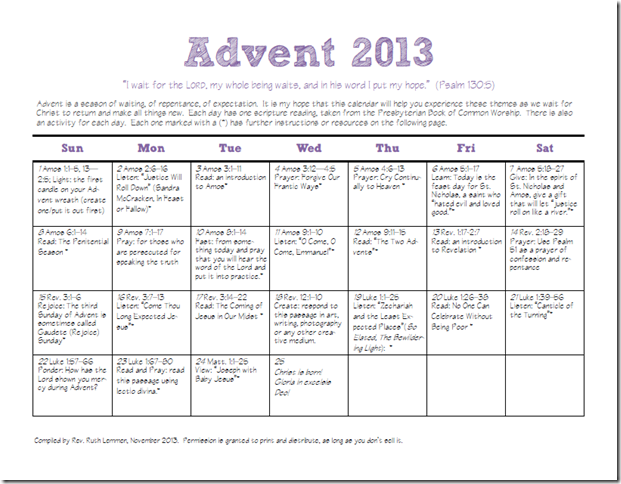
Advent Calendar Printable

This coming Sunday, December 1, is the first week of Advent.  Advent might be my favorite season of the church year—you can look forward to a number of Advent themed posts in the coming weeks.  It is a time of expectant waiting.
A few weeks ago, my sister wrote to me and asked if I had any suggestions for Advent calendars.  She wanted to make one, but wasn’t sure of what activities to put on it that a) weren’t geared for kids and b) had some spiritual significance.  I did a tiny bit of internet browsing and couldn’t come up with anything that was workable, either. So I decided to create my own.  I assigned one scripture for each day and then an activity.  The activities vary and are at least loosely connected to the scripture.  Some samples: listening to “Zechariah and the Least Expected Places,” using Psalm 51 as a prayer of confession, choosing something joyful to do, and reading a passage with lectio divina (instructions included).  Although this isn’t written specifically with children in mind, I think you could easily use it with older children and teenagers.   advent calendar
I enjoyed putting this together, and I’m looking forward to using it myself.  If you are looking for something to guide your reflection during Advent and help you engage the themes of Advent—and the God who came in the flesh and will come again—please feel free to use it, too.  It is available as a free printable.  You are free to print and distribute this, but I do ask that you don’t sell it—I’m making it available for free and would like to keep it that way.  Have a blessed Advent!  

November 21, 2013

Imaginative Reading and Building A File

IMG_4690One of my favorite seminary classes was called Imaginative Reading for Creative Preaching, taught by then President Neal Plantinga and Professor Scott Hoezee.  I loved it because we read all kinds of wonderful books and talked about them with an eye to preaching.  We also had to collect quotes and observations from our reading as a start to a file.  I dreamed that as a pastor, I would be a voracious reader and my file would grow quickly.
But once I was a pastor, I didn’t read as much as I thought I would.  I was busy with meetings, answering e-mail, writing sermons, visiting people, and many more tasks.  One of my regrets about my first years of ministry is that I didn’t better protect time to read widely.  When I did read, I didn’t take the time to note those passages and themes I should save for later, so my file stayed about the same size.  On my list of things-I-want-to-do-better the next time I’m a pastor is read widely and be disciplined enough to add to the file. 

Perhaps you are wondering why it is important for me to read as a pastor.  Neal Plantinga has taken his thinking about this topic and discussions from classes and seminars he has led and crafted them into a new book called Reading for Preaching: The Preacher in Conversation with Storytellers, Biographers, Poets, and Journalists.  The premise of the book is that preachers should read widely because it helps us gain wisdom, improve our use of language, interact with new ideas and people, and find the best material for sermons. 

I studied English for my undergraduate education, and once I was in seminary I realized that all that reading and discussing and writing I did had taught me to do most of those things.  I had entered Tennyson’s grief at the death of a friend in his poem In Memoriam A.H.HI had grappled with stereotypes in Shakespeare’s Merchant of VeniceI experienced Hester Prynne’s guilt and shame in The Scarlet LetterAll of those experiences make me a better pastor, preacher, and person.
Reading brings me great joy—I love getting to know new people through a novel or seeing things in a new way from a poem.  Thankfully, Plantinga says to enjoy it.  “Good reading generates delight, and the preacher should enjoy it without guilt.  Delight is a part of God’s shalom and the preacher who enters the world of delight goes with God” (pg. x).  Plantinga’s blessing and exhortation in this book really encouraged me to be more intentional about reading and the less delightful (but important) process of recording some of my discoveries.   

At the same time, I have figured out some practical tips of what works for me which makes me much more motivated to do it.  First, the question of what to read.  My problem is usually having too many books to read at any particular time, but I often try to rotate through novels, non-fiction, and poetry.  Plantinga suggests “Just one novel a year?  And one biography?  And one-fifth of a book of poetry by one poet?  And a weekly visit to the website of Arts & Letters Daily to find out what the best journalists have been saying?  Not a bad plan, I think” (pg. 42).  Sounds doable, doesn’t it!  Plantinga offers a “Selected Reading List” at the back of his book to get started from.  Another way I like to select great books is from the Recommended Reading List for the upcoming Festival of Faith and Writing.   

When I am reading, if it is a paper book I have small sticky tabs that I place at the place on a page where I find something interesting.  Then, when I finish the book I go back through and if it still seems like something I want to save, I put it into the file.  (I picked up that tip from an interview Plantinga did for the release of his book.  Don’t ask how I had forgotten to ask him what his method is when I had the class with him.)  If I am reading on the Kindle app on my tablet, I highlight parts I want to save.  Then, when I am finished I go to my online Kindle account where you can see all of what you have highlighted.  Anything I want to save gets copied and pasted into my files.  Both of these methods have been working really well for me!

I keep my file in Evernote, which is a free software.  You can create multiple notebooks with various notes in each.  The best part is that I can tag each note with topics (love, grief, forgiveness, etc.).  Then when I am looking for something on a theme, I check out what I’ve tagged with it.  There is also a really convenient web clipper, which makes it really easy to save blog posts and online news clippings very easily.  Keeping my file in Evernote has been a key to actually using this system; I started out doing it differently and it was too much work.  (For the record, Evernote has no idea who I am, I just really like their software.)

I’m really looking forward to the day when I’ll be preaching regularly again and be able to use my file my often.  It is a great feeling to know that I am investing time now that should pay off in the future.  And now I’m off to Burma in a young adult novel I just started called Bamboo People

November 19, 2013

Wait. Hope. Expect. Playlist

Sometime this spring I was browsing through the stores in downtown Holland, MI.  At one, I found this little plaque.  The three words captured my season of life, so I bought it--partly as a reminder to hope and expect and not only wait.  It is currently hanging out on my dresser to keep reminding me that waiting comes to an end.

A few weeks ago, I was reading Who's Got Time: Spirituality for a Busy Generation.  I'll write more about it in the coming weeks, but it is chock full of interesting takes on spiritual disciplines--one of them is creating playlists.  I was inspired to make a playlist of songs that capture these three verbs.  I have been playing it ever since, giving words and feeling to the waiting, helping to have hope, and encouraging me to expect that God is working.  It starts with "From deep distress / and troubled thoughts / to you, O God / we raise our cries."  It journeys to "a mass grave / no one can raise.  / But you said "live" / and the ground it gives"  and to God "slipping out of underneath rocks / in alleys off the beaten path."  It ends with a benediction: "Christ be with me / Christ before me/ Christ behind me."  Wherever you are on your journey, may these songs bless you as they have blessed me.  If you have Spotify (its a free download), you can listen to most of the songs below.  The three that Spotify doesn't have I provided a link to in the list below.

1. "From Deep Distress," The Water and the Blood, Sojourn
2. "Wait," Meet Me At the Edge of the World, Over the Rhine
3. "Keep Breathing," Be Ok, Ingrid Michaelson
4.  "I'll Wait," Invisible Empires, Sara Groves
5.  "I Will Wait," Babel, Mumford and Sons
6.  "The Wait," Desire Like Dynamite, Sandra McCracken
7.  "A Far-Off Hope," Love & War & The Sea In Between, Josh Garrels
8. "All the Stars," The Blood and the Breath, Caroline Cobb
9. "Love's Redeeming Work is Done," Love Shall Be Our Token, High Street Hymns
10. "Dry Bones," The Blood and the Breath, Caroline Cobb
11. "I Hope You Dance," I Hope You Dance, LeeAnn Womack
12. "Holding On To Hope," Faint Not, Jenny & Tyler
13. "Zechariah and the Least Expected Places," The Bewildering Light, So Elated
14. "He's Always Been Faithful," The Collection, Sara Groves
15. "Refuge," Over the Grave, Sojourn
16. "Strangely Ready," The Collection, Sara Groves
17. "Abiding City," The Builder and the Architect, Sandra McCracken
18. "Christ Be With Me," The Brilliance, Brilliance


August 15, 2013

On My New Found Love of Poetry

When I was in seminary, I heard Eugene Peterson speak at the Festival of Faith and Writing.  He was asked what advice he would give to young pastors.  I think he had three pieces of advice, but I only remember two.  Those two have stuck with me, though: learn Biblical languages really well and pick a few poets to read deeply.  I inwardly groaned at the first and was intrigued by the second.  Peterson said that as people who use language extensively, pastors should read poetry to increase your grasp of how English works.  Poets are the people who play with language—vocabulary choices, rhythm, stress, imagery, metaphor, punctuation.  He suggested picking 3-4 poets who you read regularly and get to know well.  I haven’t been as intentional as he about sticking with certain poets, but I have found myself reading poetry more in the last two years of my life than any time before.
    
Before this point in my life I have not been a huge poetry fan.  I didn’t actively dislike it, but with few exceptions I didn’t love it, either.  I am not the best poetry reader and I’m a worse poetry writer.  I did read enough poetry when I was an English major to get a sense of styles I am drawn to and those I’m not (lets just say that T.S. Eliot will never be one of the 3-4 poets I dwell one).
poetry books
So why did I start reading more poetry once I became a pastor?  I don’t think it was just because Eugene Peterson said I should or the inner English major who always wished I was better with poetry.  In the “Author Q & A” of Lauren Winner’s Still: Notes on a Mid-life Faith Crisis she talks about why she reads and writes about poetry.  Winner bases her answer on an observation by Richard Rohr that our spiritual lives have two halves—the season where you build a spiritual identity and the season where you face crisis and come to know God in a deeper way.  “Rohr says that in the second half of your spiritual life you may find yourself reading a lot of poetry.  Maybe, before, you read dogmatics or self-help how-tos or narrative history.  Before, poetry may have seemed elusive and loopy.  In the second of Rohr’s two halves, you like the space that poetry offers” (pg. 205-206). 

In the messiness of being a pastor, I like that space poetry offers.  Every day I face questions and ambiguities about faith and life.  There are the questions that inevitably come with reading scripture.  There are difficult situations in people’s lives that pastors are called to walk through with them.  There are specific applications of how we love our neighborhood, like do we help this person with their rent?  And who am I in all of this; what does it mean to be a pastor? 

In the messiness, poetry gives space.  Space to be.  Space to live with the ambiguity.  Space to question and wonder and enjoy something beautiful.  In her book about being good stewards of language, Caring for Words in a Culture of Lies, Marilyn Chandler McEntyre says, “poetry can teach us specific skills that we need now more than ever to cultivate if we are to retain a capacity for subtlety” (pg. 159). 
Good poetry doesn’t try to give all the answers and tie everything up into neat bows.  It isn’t full of platitudes.  I appreciate that because it is honest and authentic.  That's the kind of person I want to be, too—someone who can hold up to the pressure of the ambiguities in my own life and others lives.  I don’t think that it is a coincidence that one of my favorite books of the Bible is Psalms, a book full of poems.  In the psalms I find that same sort of honesty and authenticity as in other poetry.  The psalmist doesn’t usually sugarcoat things.  If he (or possibly she) is angry at God or feels wronged by God, he says so directly.  The psalms don’t always wrap everything up neatly, although they almost always end with a statement of trust in God.  The psalms, and other poems, give space to live with the ambiguity that comes from living in a broken world.  Poems can also point us towards  the hope that we have in Christ, that things are ultimately secure, even if they appear to be falling apart

I’m going to keep reading poetry, to keep finding that space and keep honing my skill with language.  I’ll keep sharing some of my favorite poems here, as I’ve done in the past.  The poets I have read the most in the past couple of years (in addition to the Psalms) are Scott Cairns, Mary Oliver, Robert Frost, and Luci Shaw.  The Poetry of Robert Frost is on my bed stand right now, so perhaps he’ll show up here next. 

Photo by Liesbeth den Toom, used under a Creative Commons License.

June 30, 2013

Sunday Afternoon Prayer: All Things Bright and Beautiful

Lake Michigan from a trail along one of the dunes
 at Nordhouse Dunes National Wilderness Area
I did a lot of thinking while I was in the woods this weekend. Besides my gratefulness to my mom, I thought about this hymn, "All Things Bright and Beautiful," a lot. When I got home I looked it up and discovered: "Cecil F. Alexander (PHH 346) wrote a number of hymn texts on articles of the Apostles' Creed. This text, whose biblical source is Genesis 1:31 ("and God saw all that he had made, and it was very good"), is Alexander's explanation of the Creed's phrase "Maker of heaven and earth" (Psalter Hymnal Handbook, from hymnary.org).
This afternoon, may we raise our voices to praise the maker of heaven and earth.

Refrain:
All things bright and beautiful,
all creatures great and small,
all things wise and wonderful,
the Lord God made them all.


1 Each little flower that opens,
each little bird that sings,
he made their glowing colours,
he made their tiny wings: Refrain

2 The purple-headed mountain,
the river running by,
the sunset, and the morning
that brightens up the sky: Refrain


3 The cold wind in the winter,
the pleasant summer sun,
the ripe fruits in the garden,
he made them every one. Refrain


4 He gave us eyes to see them,
and lips that we might tell
how great is God Almighty,
who has made all things well. Refrain

Source: Church Hymnary, Fourth Edition #137a


Personal Photo, June 2013

May 14, 2013

Grains of Hope

“We have, what do you call it, a small bit of wheat at the end of stalk, a grain.  We have what you would call, grains of hope.  When I face, when I am in darkness, even there when I am beaten and tortured every day, I have hope.  I do not stop.  That is what keep me alive.” 

These words came from the lips of a man who came as a refugee to Grand Rapids, and they became the title of the play Grains of Hope.  Grains of Hope is an ethnographic play created by Stephanie Sandberg and the Calvin Theater Company.  Stephanie and Calvin students interviewed over 100 people in West Michigan who came here as refugees or work closely with refugees.  From those interviews, she chose 7 stories—7 people—to feature at the center of the play.   An 18 year old woman who came to Grand Rapids from Vietnam with her family when she was three years old.  A man who fled Sudan as a child and when he eventually came to Grand Rapids, all he knew of America was Mickey Mouse printed on a t-shirt.  A Bhutanese man who spent 15 years of his life living in a refugee camp in Nepal in a simple bamboo house with dirt floors.  In the play, actors brought each of these characters to life using their own words from the interviews.  

They told of how they came to be in Grand Rapids and what they have faced since they arrived.  Stories of the difficulties of learning English and finding work.  They told stories of struggles to find good and affordable housing.  And they told stories of friendship and the people who have helped them along the way--middle school teachers, caseworkers, and doctors, an English tutor who became a friend, an older woman who became a family’s adopted mother and grandmother.

This play was performed 13 times in various locations around Grand Rapids over the last few weeks.  My congregation was privileged to host one of the performances last Sunday evening.  We have been active in working with refugees for many years, and several of the people who appeared in the play were members of our church who have developed relationships with families who came as refugees.  It was moving to see their dedication over the years brought to life. 
An actress telling the story of a woman who came from the DR Congo
As I watched the play, there were points where I was almost in tears at the stories.  Even the people who I don’t know personally have elements of their stories that are similar to stories I have heard from people that I know.  These are people that have welcomed me into their homes with various kinds of chai, fruit, and other snacks.  Who seem glad to have me there, even if much of the conversation around me is in a language that I don’t understand.  Who have loved me and prayed for my mom when she had surgery last winter.  They are people who have come through horrific circumstances to a new life in America.  And that life isn’t necessarily easier—safer and with a higher material standard of living, perhaps—but with the new challenges of DHS who cuts benefits (like food stamps) if you miss a letter or appointment, a mind-bogglingly complex medical system, and a culture that is independent to the extreme. 

I am so inspired by the people I know who arrived here as refugees.  I have seen Christ in them, again and again.  I am thankful for the opportunity to get to know so many of them in the past few years.  I have seen their hope, even in midst of despair.  I hope some of that has rubbed off on me.  And I hope that I and churches across North America would offer the friendship that gives hope to dealing with the transitions.  I pray that we would reflect Christ to our friends, because Jesus is the source of true hope.


Resources:


Wheat photo by Marilylle Soveran, http://www.flickr.com/photos/86953562@N00/47812279/, used under a Creative Commons License.
Play photo from Calvin College publicity, http://www.calvin.edu/news/archive/grains-of-hope

April 07, 2013

Sunday Afternoon Prayer: A Prayer for the Year to Come


I'm continuing the birthday theme for one last post (previous here and here), with my prayer for the coming year of my life.


Thank you for your faithfulness in the past year,
For grace in difficult situations,
For growth as a pastor
For relationships that have supported me.

And in this year to come, may I be a person of
Strength,
Joy,
Stability, and
Hospitality.

May I grow in my
relationship with you,
prayer life,
memorized scripture, and
identity in Christ.

May I live in community with friends
Near,
Far,
Old, and
New.

May I serve you
Faithfully,
With wisdom,
With self-less love for others, and
Wherever you call me.

May I be filled with joy
Exploring your creation,
Creating beautiful things,
Laughing with friends,
And trying new things.

Whether in word or in deed,
Be done in the name of Jesus.

In Jesus’ name.  Amen.


Personal photo taken in the Iona Abbey, Iona, Scotland, January 2013. 


January 22, 2013

UK #12: God Gathers, Protects, and Preserves


I wrote this on the plane, somewhere over the Atlantic off the coast of Greenland, and my way home (where I did arrive safely).  I have lots of specific stories to share in the coming days, but for this post I am going to focus on a theme that I have found again and again on this trip.  
A cross on the island of Iona, with the parish church in the background
 People have said the church in Europe is dying, or even dead.  When I talked to Rosie, she said that people have questioned why she is going into ministry, since the church is going to be gone in ten years.  And the church certainly doesn't have the cultural prominence that it once did.  But the church is not dead.

As I visited churches, from York Minster's Gothic arches to cushions on the floor at Holy Trinity Brompton in London (more on that in another post), the words of the Heidelberg Catechism echoed in my head: "God gathers, protects, and preserves [the church] for himself" (Q&A 54).  This is one of my favorite phrases in the Catechism because it reminds me that the church doesn't belong to me, or my congregation, or denomination.  We are God's church, God's people gathered in the world, and God is sovereign.
York Minster
God has been gathering the church for thousands of years.  Most of a thousand years in Britain alone.  God has passed down scripture through the ages--I saw Codex Sinaiticus at the British Library, which is the earliest manuscript of the complete New Testament from the middle of the fourth century (and it has the earliest and best witness for some Old Testament books).  It was all copied by hand in Greek.  It was moving to see how God passed his word from generation to generation.  God isn't going to drop the church now.  
So yes, the church looks different than it did 100 years ago.  
Yes, there are empty church buildings.  
Yes, it is not easy to be a Christian in Britain these days. 
St. Margaret's Chapel, the oldest building in Edinburgh
But no, the church is not dead.  In fact, the church is growing in places.  I think because Alpha courses at starting now (or Christianity Explored at All Souls), many of the Sunday services I attended interviewed a member of the congregation that was a new Christian because of these courses.  So I got to hear a number of stories of how the church is growing because of evangelism. It was encouraging to see these new brothers and sisters in Christ and hear about how Jesus has changed their lives.

The church is not dead because God is not dead.  God is alive, and he continues to gather, protect, and preserve for himself the body of Christ. 

Worship at Holy Trinity Brompton in London
This is just as true of the church in the U.S., too.  I have heard that denominations are going to be gone in 10 years.  Our culture is changing.  It isn't as easy to be a Christian as it once was.  But I trust that God is still in control. Maybe the church will look different in 10 years.  If it does, I hope that we are as creative as some of the British churches.  I hope that we become as welcoming to different sorts of people without knowledge of the church. And I hope that we will see people of all ages being found by God and entering the church.  I look forward to serving this church and watching how God will continue to gather, protect, and preserve us.

January 12, 2013

UK #7: The Iona Community

Iona Abbey
One of the reasons the Isle of Iona has contemporary significance and is well-known in some Christian circles is the Iona Community. I think in North America we sometimes think of them as being the whole island, but they are not. In fact they share the abbey with Historic Scotland who cares for and manages the site. 

In the 1930s, in the midst of the Great Depression, a pastor named George MacLeod came up with the idea to restore the abbey using unemployed craftsmen and young pastors (so they would have training before they went to urban missions). In addition to their construction work, they practiced living in community. Today the Iona Community is "an ecumenical Christian community of men and women engaged together, and with people of goodwill across the world, in acting, reflecting,and praying for justice, peace and the integrity of creation; convinced that the inclusive community we seek must be embodied in the community we practice." It is a sort of untraditional monastic order. Members commit to live by a shared rule which includes daily prayer and Bible reading, mutual accountability for use of time and money, meeting together, and action for justice and peace. There are about 300 members, mostly in Britain. They are divided into geographical family groups. There are also 1450 associate members and 1250 friends scattered across the world "from Michigan to Malawi." 

The abbey on Iona serves as a sort of base. There is a core group of resident staff, and from March to October they offer week-long experience of living in community for people from around the world. They also maintain daily worship at the abbey, which is open to the public. I joined in a couple of their morning prayer services while I was on the island. They were small, quiet gatherings with a few songs, prayers of confession and intercession, and a scripture reading. Each day in their intercessory prayer, they pray for specific countries, specific needs, and specific members of the community (on a cycle that all members follow). 
Chapel where worship is held in the winter

 Before coming, I was probably most familiar with the Iona Community's publishing and especially liturgical resources. I think that is probably what has made the biggest worldwide impact. We have used some of their liturgies at ÇOS (an excerpt I shared). Many songs we sing regularly come through the Wild Goose Resource Group: "He Came Down, " "Take, O Take Me As I Am," "Your Will Be Done On Earth," "Come Now, O Prince of Peace," "Come All You People" and more. 

 What I knew less about was the Community's commitment to advocate for social justice and peace. In the Abbey church, they have some displays about different justice issues. Their shop is completely fair trade (much of it local). It was a great place to do a bit of shopping. I am not exactly sure what this commitment looks like in the everyday life of a member, but I would be curious to find out some day. Looking at this ancient building and place and seeing Christians confront modern problems and experiences is inspiring. Throughout my trip so far, I have noticed that trend--communities breathing new life into old places and practices without demolishing the old. 
Displays on social justice issues
I am fascinated by the idea of living in community, while not actually living together. Things like their rule bind them together, but they can actually be spread apart. I wonder what this could look like in other situations. I am thinking especially of pastor-types who make friends and have community, but move often. This question of how to have community when people keep moving or getting married and moving, knowing there is a good chance I'll be moving this summer has been on my mind in the past few months.
St. John's cross (modern replica)
 I wonder if we could create a community for ourselves based not on living near each other, but on a rule that we would create and a commitment that we would continue to support each other. I think our rule would look a bit different than the Iona Community, but I think it could work. I would be interested to try.

January 01, 2013

Christmas Ornament Stories: My Ordination

Welcome to any new COS readers!  I am travelling today, so I am sharing the last post in a series about my Christmas tree ornaments.  My next post will be an update on my trip!

Every ornament tells a story.  That’s the basic philosophy of my Christmas tree.  During this Christmas season (and I’m including the church calendar Christmas season, which goes to January 6), I am introducing you to some of my favorites and sharing the story behind them.  So far, I have shared ornaments from my parents, grandparents, and aunt and uncle.

Today’s ornament is one of my newest ornaments.  I made this one myself at the end of last year’s Christmas season.  Sometime in the fall, I saw this idea on Pinterest made with a wedding invitation or program as a wedding gift.  As soon as I saw it, I knew I wanted to make one for myself with my ordination bulletin/liturgy.  My ordination was on January 1, 2012—one year ago today.  The next week I made myself this ornament.  It was probably my favorite to pull out of the box this year, because it reminded me of that joyous day.  The day the church said: “Yes! We publicly affirm God’s call in your life to serve in ordained ministry.”  The day that I vowed to love, serve, and lead the church.  It was one of the most important days of my life, and this ornament reminds me of it.

As I look back at one year of ordination, it has been a hard year and a joyful year.  I have seen human brokenness in new ways.  I have been stretched and wondered if I could do this for the rest of my life.  I have mined God’s Word for his word to us in this time and place.  I have been honored to be with people as they spend their first few months in this country.  I have been blessed by the love and support of the church council.  I have watched young leaders grow.  So even though it isn’t an easy calling, today I reaffirm my vows. 

With God helping me, I believe that in the call of this congregation God himself calls me to this holy ministry.
With God helping me, I believe that the Old and New Testaments are the Word of God, the only infallible rule of faith and life.
With God helping me, I subscribe to the doctrinal standards of this church, rejecting all teaching which contradicts them.
With God helping me, I promise to be a faithful minister, to conduct myself in a manner worthy of my calling, and to submit to the government and discipline of the church. (CRCNA Form for Ordination of Ministers)

Thanks be to God!

December 11, 2012

Christmas Ornament Stories: My Grandparents’ Faith


Every ornament tells a story.  That’s the basic philosophy of my Christmas tree.  During this Christmas season, I am introducing you to some of my favorites and sharing the story behind them.  First were some creative ornaments from my parents.

Today’s ornament is from my Grandpa and Grandma.  Pretty much every year, they gave all the grandkids an ornament.  I have some they bought while volunteering in Salt Lake City, some they bought in Mexico while they wintered in Tucson, and several that they made (the creative part runs in the family).

This one is my favorite.  It is also the last one, because it is from my grandma’s last Christmas with us.  They worked together on this one.  They developed the idea and found the pattern together.  My grandpa did the cutting and sanding.  This angel reminds me of their deep faith that they passed on to us. 

In the last few years, I have become increasingly thankful that the faith they passed on is a well-rounded faith.  They were (and are) people of great piety.  They kept a drawer of Bible story books to use when the grandkids came to visit.  They wanted to help us learn the stories of faith and the practice of family devotions.  For their 50th wedding anniversary, the family gave them a Bible that each of the kids and grandkids had marked some of their favorite verses in.  In the years since, both Grandma and Grandpa have added notes of passages that are significant to them.  It is a wonderful physical heirloom of faith.

But their faith is more than knowing the Bible well and having right theology.  Their faith has legs.  It showed itself us in the care they show—the gifts, showing up on all sorts of occasions, being good friends and faithful church members.  And it showed itself in the way they spent their time.  Instead of going to Florida for the winter to go golfing and shopping, they went to Tucson to volunteer at a fledgling Christian high school.  My grandpa is a Christian school teacher by trade, and so every winter he helped this school as it grew.  He did everything for them from substitute teaching to digging ditches and building things.  Grandma helped to work in the library.  Their selfless care for others was a living model for us and shaped our family.  I would not be the same person without them.  I thank God for them, and for this ornament that reminds me of my heritage.

December 07, 2012

Purple Fabric and Metallic Thread--My Advent Stole


“The people walking in darkness have seen a great light;
on those living in the land of deep darkness a light has dawned” (Isaiah 9:2).

This verse, plus a number of pictures of other stoles, inspired the design for my new Advent stole.  Stoles help me and my congregation to mark the passage of time through the Christian calendar.  Like people wear snowman earrings during December or red, white, and blue on 4th of July, pastors in robe-wearing-churches wear stoles to remind us of the season.
 

My mom and I created this stole.  It is purple, the traditional color of fasting and penitence and the color of the royalty of the coming king.  It also has some blue, a newer Advent color of hope and anticipation.

It features a road for the people walking in darkness.  And it is the journey that we are all on, the journey of waiting and expectation, living in the already-but-not-yet.  


And at the end of the road is the star.  I chose this star, a natal star cross, because it is a 4 pointed star Bethlehem star plus a cross.  It reminds us that the light came as a baby in Bethlehem, but he brought light to the whole world through his death and resurrection.

As we walk the journey of Advent this year, I pray that we would be reminded that God is faithful to his promises.  The people walking in darkness have seen a great light.  And God will remain faithful and come again to make everything new.

December 04, 2012

Christmas Ornament Stories: My Parents’ Creativity

Every ornament tells a story.  That’s the concept of my Christmas tree.  Over the next few weeks, I am going to introduce you to some of my favorites and tell you the story behind them.

When I was growing up, my parents bought my sisters and me an ornament every year.  They were always special.  Sometimes they had our name on it. Sometimes they found it in a gift shop on a family vacation.  Sometimes they represented one of our hobbies.  Mom and Dad gave them to us the evening we decorated the Christmas tree.  It was always one of my favorite nights of the year.


My mom made this ornament for Christmas 1986 (that’s helpfully stitched into the back).  I love the simplicity and the slight sheen of the floss she used.  And I love that she made it, because she made a lot of things in the first years of my life.  In most of the pictures of me as a young child I am wearing a very cute dress my mom made me.  Once we were school-aged, she turned her sewing attention to costumes.  Betsy Ross, a Seminole Native American, and a medieval royal were some of the costumes she created for me.  She passed on her resourcefulness and some of her crafting and sewing abilities to me.


This is the ornament they gave me when I was in first grade.  That year, we were studying the middle ages at Christmas time, so this is the closest my mom could come to a medieval ornament.  A week or so before Christmas we had a reenactment of a medieval feast with a few other families.  We all had costumes.  The dining room was arranged to look like the great hall of a European castle.  Each family created a banner to represent the tapestries found in castles (I think my parents still have the one we made).  We were the entertainment between courses.  One of my friends juggled.  Another told jokes.  I recited the poem “Four and twenty blackbirds baked into a pie.”

The best part was the dessert.  It was a castle cake!  The moms planned how to bake cake in coffee cans and loaf pans and get it to stay together like a castle (in the days long before Pinterest).  I think she stayed up late and got up early to put it together, because I was totally surprised.  Standing guard at the drawbridge was this ornament (and my sister’s similar one).  I had noticed that morning that it was missing from the tree.  I was delighted and surprised that it was part of this magnificent cake.  So every year when I put this ornament on the tree, I am reminded of that cake and the many, many hours my mom invested in giving me an excellent education.