Showing posts with label spiritual practices. Show all posts

January 05, 2014

Sunday Afternoon Prayer: Give Us the Attentiveness of the Wise Men

“Where is the newborn king of the Jews? We saw his star as it rose, and we have come to worship him.” 
--Matthew 2:2, NLT
Tomorrow is Epiphany in the church calendar, when the church traditionally remembers the arrival of the wise men to worship Jesus.  In that tradition I offer this prayer inspired by their worship.

IMG_5007Almighty God who took on infant flesh,
you were worshipped by shepherds and wise men,
people who searched for you with passion,
all to worship Jesus.

Give us the attentiveness of the wise men,
who noticed the oddity in the sky,
and followed it,
all to worship Jesus.

Give us the perseverance of the wise men,
who travelled from a far off land,
through deserts and dangers,
all to worship Jesus.

Give us the generosity of the wise men,
who brought costly gifts,
fit for a dying king,
all to worship Jesus.

Give us the joy of the wise men,
who rejoiced when they arrived in Bethlehem,
finally reaching their goal,
all to worship Jesus.

May we worship you,
with attentiveness,
with perseverance,
with generosity,
and with joy.
In Jesus' name.  Amen.

Personal photo (of a nativity scene I made), January 2014.

December 05, 2013

Boxing Lament, Creating Playlists, and Backwards Parties: Spiritual Practices for a Busy Generation

I was talking with a clergy colleague/friend recently about an intergenerational study she is putting together for her congregation about spiritual disciplines.  We talks a bit about the different resources she is (and could) pull from.  There are a number of books about spiritual disciplines published.  I had never heard the term “spiritual discipline” until I was in college.  I was introduced to the term and the concept through Richard Foster’s Celebration of DisciplineMy family and church community had certainly practiced spiritual disciplines (some better than others), but I had never seen them all laid out and talked about as a whole. 
51m rLUW5kL._BO2,204,203,200_PIsitb-sticker-arrow-click,TopRight,35,-76_AA278_PIkin4,BottomRight,-66,22_AA300_SH20_OU01_In the years since, I have read a number of such books at different points in my life.  Each has a slightly different tone and focus.  Most recently I read Who’s Got Time: Spirituality for a Busy Generation by Teri Peterson and Amy FettermanIt is one of the newest titles in the Young Clergy Woman Project imprint with Chalice Press.  Peterson and Fetterman are both youngish pastors and they wrote this primarily for people in their generation.  People who grew up with computers.  People who grew up moving frequently and far from extended family.  People who are marrying later and later or not marrying at all.  People who struggle to find work and if they do expect to change jobs regularly for the rest of their life.
Peterson and Fetterman do a great job of suggesting ways to practice spiritual disciplines (both classic and new) in the busy, hyper-connected life most of us live.  I really appreciated their practicality and creativity.  As much as a I respect Foster’s work, Celebration of Discipline doesn’t include a chapter on social media. 
Here’s a sampling of some of the ideas that I found interesting (they cover more traditional disciplines, like fasting, too).  Chapter two is called “In the Body,” and it explores “ways we can exercise our spirits as we live in flesh and bone.”  One of their suggestions is to incorporate a piece of scripture into a boxing (or kickboxing?) routine.  They say “Amy’s personal favorite combo includes Psalm 61:1 and goes like this: Hear *jab* my *jab* cry *right hook* O *left hook* God *backfist*.”  I may or may not actually try this one myself, but a physical lament sounds awesome!
Chapter four is all about using music in the life of faith.  One of my favorite ideas from the chapter I already shared on the blog—making playlists.  They suggest peace and righteous anger playlists.  I made a wait. hope. expect. playlist that helps me to wait with hope during this period of my life.
They also have a chapter on rituals that I found inspiring.  They wonder “How do we organize our hopes, dreams, fears, realities, loves, losses, and find a sense of the Holy in the midst of them? How do we mark these life events that don’t have rituals already attached to them the way marriage or kids do?…We believe there is a way to create ritual that makes meaning out of the lives we live now, as twenty-first–century young adults” (ch. 5).  One of the examples they give is a “backwards party” when one of their friends was moving away.  They started by saying goodbye, ate dessert, then dinner, and ended with saying hello.  It was a ritual that helped this group of friends to transition to a new phase of their friendship.  I haven’t started any new rituals yet, but I’m thinking of opportunities.
There are lots more ideas in the book, and I would encourage you to check it out for yourself if you are looking to grow in your spiritual walk.  I would add a note that I am a bit more conservative in theology than the authors, and a few ideas I’m not sure I’d be comfortable trying.  But that doesn’t mean they don’t have lots of good ideas and true thoughts.  

November 28, 2013

Thanksgiving Standing Stones 2013

I have a tradition at Thanksgiving to make a list of “standing stones”—the things that I look back on in the year and say “look at what God has done.”  Last year was full of big and joyful milestones, like being ordained.  This year is a bit more subdued, especially the last few months.  But still, I am thankful for the opportunities and gifts God has given me this year. 
IMG_0882

Travelling to the UK for three weeks in January.  I got to experience the church and culture, which despite common stereotypes, caused me to say look what God is doing!


IMG_0068

Performing my first baptisms of two young people that came to the United States as refugees.  Their faith is rich, deep, and growing as they have faced many difficulties in their short lives.  I am thankful that I got to be a small part of their stories.


IMG_1440

I got to go on lots of short camping trips this Spring, Summer, and Fall.  It was wonderful to spend lots of time outside hiking, eating, reading, watching birds, and enjoying the wonders of God’s creation.  (If you’re curious, the photo is from May in Tahquamenon State Park Rivermouth Semi-Modern Campground.)
IMG_2653

My pastoral residency at Church of the Servant, which ended at the end of July.  This one is definitely bittersweet—I really miss being a pastor there, but I am so overwhelmingly grateful for the two years I got to spend there learning, loving, preaching, visiting, baptizing, welcoming, and being loved.


IMG_3750

The two weeks I got to spend in Colorado and Wyoming during October.  I spent time with Mary and Jared (my sister and brother-in-law), and my friend Allison and her family.  I saw a whole new part of God’s creation—an exhilarating part.  I even climbed mountains, sort of.  At least I went on a short hike above the treeline.  
7935228564_f035829e3a_o

Having a spiritual director who helps me each month to see what God is doing in my life.  I am thankful for her support and encouragement that God is working in me, even when I can’t see exactly what God is doing yet.
733829_610479004214_187675179_n

I am so thankful for the gift of friends who have listened to me, waited with me, encouraged me, prayed for me, discerned with me, and loved me.  I really would not have made it through these years without them.


“Save us, Lord our God, and gather us from the nations, that we may give thanks to your holy name and glory in your praise.”
-- Psalm 106:47

Photo of spiritual direction feet by Michelle Kroll, used under a Creative Commons License.  All other photos are my own.

November 26, 2013

Advent Calendar Printable

This coming Sunday, December 1, is the first week of Advent.  Advent might be my favorite season of the church year—you can look forward to a number of Advent themed posts in the coming weeks.  It is a time of expectant waiting.
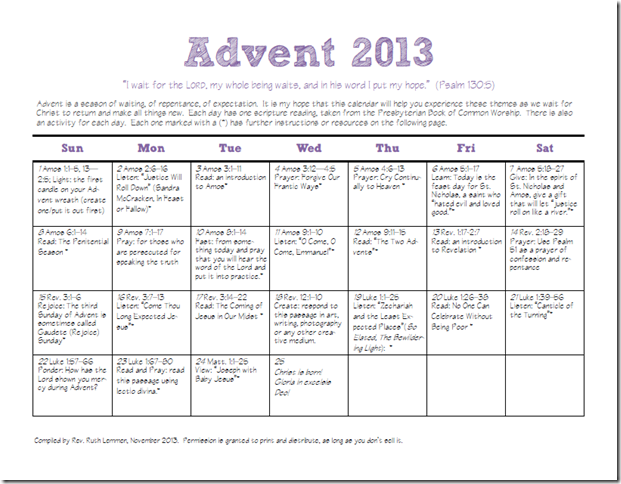
A few weeks ago, my sister wrote to me and asked if I had any suggestions for Advent calendars.  She wanted to make one, but wasn’t sure of what activities to put on it that a) weren’t geared for kids and b) had some spiritual significance.  I did a tiny bit of internet browsing and couldn’t come up with anything that was workable, either. So I decided to create my own.  I assigned one scripture for each day and then an activity.  The activities vary and are at least loosely connected to the scripture.  Some samples: listening to “Zechariah and the Least Expected Places,” using Psalm 51 as a prayer of confession, choosing something joyful to do, and reading a passage with lectio divina (instructions included).  Although this isn’t written specifically with children in mind, I think you could easily use it with older children and teenagers.   advent calendar
I enjoyed putting this together, and I’m looking forward to using it myself.  If you are looking for something to guide your reflection during Advent and help you engage the themes of Advent—and the God who came in the flesh and will come again—please feel free to use it, too.  It is available as a free printable.  You are free to print and distribute this, but I do ask that you don’t sell it—I’m making it available for free and would like to keep it that way.  Have a blessed Advent!  

November 24, 2013

Sunday Afternoon Prayer: Confession for Christ the King

This morning I was privileged to lead the confession and assurance during worship at Hamilton (MI) CRC.  I share here the words and prayer I led. 
9195944224_1bfedb8ba8_o

In the church year, today is Christ the King Sunday.  This is a Sunday to remember that Jesus is the King of kings and Lord of lords.  And it is a day to remember Christ must reign in our hearts, minds, and bodies.  But as we look at our hearts, minds, and bodies, we see how we have set ourselves up as king.  Let us confess that sin before God and each other. 

Gracious God,
You gave Jesus the highest name, that at the name of Jesus every knee should bow and tongue confess that Jesus is Lord.
But so often we refuse to bow.  We want to stand and be our own lords.
Our hearts are full of pride that thinks first of ourselves. 
We are selfish with our time, our abilities, and our money.
Lord have mercy.  Christ have mercy.

Our minds do not always acknowledge your kingdom.
We assume that we are right and everyone else is wrong. 
We use our minds to judge people who are different from us
Lord have mercy.  Christ have mercy.

We use our bodies for our own purposes instead your purposes.
We use our bodies to hurt other people and your good creation.
We also do harm to our bodies by not caring for them well.
Lord have mercy.  Christ have mercy.

In your great mercy and love, forgive us, Lord.  In the name of Jesus we pray.  Amen.

Even though we rebel against Jesus’ kingdom, God still loves us.  Hear these words: (Recited by two young boys from the congregation)
1 John 4:10-11
"This is love: not that we loved God, but that he loved us
and sent his Son as an atoning sacrifice for our sins.
Dear friends, since God so loved us, we also ought to love one another.”
People of God, know that you are forgiven and live at peace.


Photo by Jason Train.  Used under a Creative Commons License.


November 19, 2013

Wait. Hope. Expect. Playlist

Sometime this spring I was browsing through the stores in downtown Holland, MI.  At one, I found this little plaque.  The three words captured my season of life, so I bought it--partly as a reminder to hope and expect and not only wait.  It is currently hanging out on my dresser to keep reminding me that waiting comes to an end.

A few weeks ago, I was reading Who's Got Time: Spirituality for a Busy Generation.  I'll write more about it in the coming weeks, but it is chock full of interesting takes on spiritual disciplines--one of them is creating playlists.  I was inspired to make a playlist of songs that capture these three verbs.  I have been playing it ever since, giving words and feeling to the waiting, helping to have hope, and encouraging me to expect that God is working.  It starts with "From deep distress / and troubled thoughts / to you, O God / we raise our cries."  It journeys to "a mass grave / no one can raise.  / But you said "live" / and the ground it gives"  and to God "slipping out of underneath rocks / in alleys off the beaten path."  It ends with a benediction: "Christ be with me / Christ before me/ Christ behind me."  Wherever you are on your journey, may these songs bless you as they have blessed me.  If you have Spotify (its a free download), you can listen to most of the songs below.  The three that Spotify doesn't have I provided a link to in the list below.

1. "From Deep Distress," The Water and the Blood, Sojourn
2. "Wait," Meet Me At the Edge of the World, Over the Rhine
3. "Keep Breathing," Be Ok, Ingrid Michaelson
4.  "I'll Wait," Invisible Empires, Sara Groves
5.  "I Will Wait," Babel, Mumford and Sons
6.  "The Wait," Desire Like Dynamite, Sandra McCracken
7.  "A Far-Off Hope," Love & War & The Sea In Between, Josh Garrels
8. "All the Stars," The Blood and the Breath, Caroline Cobb
9. "Love's Redeeming Work is Done," Love Shall Be Our Token, High Street Hymns
10. "Dry Bones," The Blood and the Breath, Caroline Cobb
11. "I Hope You Dance," I Hope You Dance, LeeAnn Womack
12. "Holding On To Hope," Faint Not, Jenny & Tyler
13. "Zechariah and the Least Expected Places," The Bewildering Light, So Elated
14. "He's Always Been Faithful," The Collection, Sara Groves
15. "Refuge," Over the Grave, Sojourn
16. "Strangely Ready," The Collection, Sara Groves
17. "Abiding City," The Builder and the Architect, Sandra McCracken
18. "Christ Be With Me," The Brilliance, Brilliance


August 15, 2013

On My New Found Love of Poetry

When I was in seminary, I heard Eugene Peterson speak at the Festival of Faith and Writing.  He was asked what advice he would give to young pastors.  I think he had three pieces of advice, but I only remember two.  Those two have stuck with me, though: learn Biblical languages really well and pick a few poets to read deeply.  I inwardly groaned at the first and was intrigued by the second.  Peterson said that as people who use language extensively, pastors should read poetry to increase your grasp of how English works.  Poets are the people who play with language—vocabulary choices, rhythm, stress, imagery, metaphor, punctuation.  He suggested picking 3-4 poets who you read regularly and get to know well.  I haven’t been as intentional as he about sticking with certain poets, but I have found myself reading poetry more in the last two years of my life than any time before.
    
Before this point in my life I have not been a huge poetry fan.  I didn’t actively dislike it, but with few exceptions I didn’t love it, either.  I am not the best poetry reader and I’m a worse poetry writer.  I did read enough poetry when I was an English major to get a sense of styles I am drawn to and those I’m not (lets just say that T.S. Eliot will never be one of the 3-4 poets I dwell one).
poetry books
So why did I start reading more poetry once I became a pastor?  I don’t think it was just because Eugene Peterson said I should or the inner English major who always wished I was better with poetry.  In the “Author Q & A” of Lauren Winner’s Still: Notes on a Mid-life Faith Crisis she talks about why she reads and writes about poetry.  Winner bases her answer on an observation by Richard Rohr that our spiritual lives have two halves—the season where you build a spiritual identity and the season where you face crisis and come to know God in a deeper way.  “Rohr says that in the second half of your spiritual life you may find yourself reading a lot of poetry.  Maybe, before, you read dogmatics or self-help how-tos or narrative history.  Before, poetry may have seemed elusive and loopy.  In the second of Rohr’s two halves, you like the space that poetry offers” (pg. 205-206). 

In the messiness of being a pastor, I like that space poetry offers.  Every day I face questions and ambiguities about faith and life.  There are the questions that inevitably come with reading scripture.  There are difficult situations in people’s lives that pastors are called to walk through with them.  There are specific applications of how we love our neighborhood, like do we help this person with their rent?  And who am I in all of this; what does it mean to be a pastor? 

In the messiness, poetry gives space.  Space to be.  Space to live with the ambiguity.  Space to question and wonder and enjoy something beautiful.  In her book about being good stewards of language, Caring for Words in a Culture of Lies, Marilyn Chandler McEntyre says, “poetry can teach us specific skills that we need now more than ever to cultivate if we are to retain a capacity for subtlety” (pg. 159). 
Good poetry doesn’t try to give all the answers and tie everything up into neat bows.  It isn’t full of platitudes.  I appreciate that because it is honest and authentic.  That's the kind of person I want to be, too—someone who can hold up to the pressure of the ambiguities in my own life and others lives.  I don’t think that it is a coincidence that one of my favorite books of the Bible is Psalms, a book full of poems.  In the psalms I find that same sort of honesty and authenticity as in other poetry.  The psalmist doesn’t usually sugarcoat things.  If he (or possibly she) is angry at God or feels wronged by God, he says so directly.  The psalms don’t always wrap everything up neatly, although they almost always end with a statement of trust in God.  The psalms, and other poems, give space to live with the ambiguity that comes from living in a broken world.  Poems can also point us towards  the hope that we have in Christ, that things are ultimately secure, even if they appear to be falling apart

I’m going to keep reading poetry, to keep finding that space and keep honing my skill with language.  I’ll keep sharing some of my favorite poems here, as I’ve done in the past.  The poets I have read the most in the past couple of years (in addition to the Psalms) are Scott Cairns, Mary Oliver, Robert Frost, and Luci Shaw.  The Poetry of Robert Frost is on my bed stand right now, so perhaps he’ll show up here next. 

Photo by Liesbeth den Toom, used under a Creative Commons License.

August 04, 2013

Sunday Afternoon Prayer: We Are Your Children

Today’s prayer also comes from An African Prayer BookIt is a prayer from our brothers and sisters of the the Anglican Church of the Province of Southern Africa.  It is a wide-ranging prayer that covers many topics, and I am going to use an adapted version of it in a worship service I am leading tonight.  I am looking forward to leading Christian Reformed folks in Michigan in prayer using words from the Anglican Church in Africa.
63206513_f0f54fdc76_oFather, we are your children, your Spirit lives in us and we are in your Spirit: hear us, for it is your Spirit who speaks through us as we pray.
Lord hear us.
Father, you created the heavens and the earth: bless the produce of our land and the works of our hands.
Lord hear us.
Father, you created us in your own image: teach us to honor you in all your children.
Lord hear us.
Father, in your steadfast love you provide for your creation: grant good rains for our crops.
Lord hear us.
Father, you inspired the prophets of old: grant that your Church may faithfully proclaim your truth to the world.
Lord hear us.
Father, you sent your Son into the world: reveal him to others through his life in us.
Lord hear us.
Lord Jesus, you sent your apostles to make disciples of all nations: bless the bishops of this province, especially N our bishop, together with N our metropolitan, and all ministers of your Church.
Christ hear us.
Lord Jesus, for your sake men and women forsook all and followed you: call many to serve you in religious communities and in the ordained ministry of your Church.
Christ hear us.
Lord Jesus, you called your disciples to take up the cross: deepen in us a sense of vocation.
Christ hear us.
You prayed for your Church to be one: unite all Christians that the world may believe.
Christ hear us.
You forgave the thief on the cross: bring us all to penitence and reconciliation.
Christ hear us.
You broke down the walls that divide us: bring the people of this world to live in peace and concord.
Christ hear us.
You taught us through Paul, your apostle, to pray for kings and rulers: bless and guide all who are in authority.
Christ hear us.
You were rich yet for our sake became poor: move those who have wealth to share generously with those who are poor.
Christ hear us.
You sat among the learned, listening and asking them questions: inspire all who teach and all who learn.
Christ hear us.
You cured by your healing touch and word: heal the sick and bless those who minister to them.
Christ hear us.
You were unjustly condemned by Pontius Pilate: strengthen our brothers and sisters who are suffering injustice and persecution.
Christ hear us.
You lived as an exile in Egypt: protect and comfort all refugees.
Christ hear us.
You knew the love and care of an earthly home: be with migrant workers and protect their families.
Christ hear us.
You open and none can shut: open the gates of your kingdom to those who have died without hearing your gospel.
Christ hear us.
You have been glorified in the lives of innumerable saints: give us strength through their prayers to follow in their footsteps.
Christ hear us.
Father we know that you are good and that you hear those who call upon you: give to us and to all people what is best for us, that we may glorify you through your Son, Jesus Christ our Lord, who is alive and reigns with you and the Holy Spirit, one God, now and forever.
Amen.


From “An Anglican Prayer Book 1989, Church of the Province of Southern Africa” in An African Prayer Book, Selected and with Introductions by Desmond Tutu, Image/Doubleday New York, 1995.
 
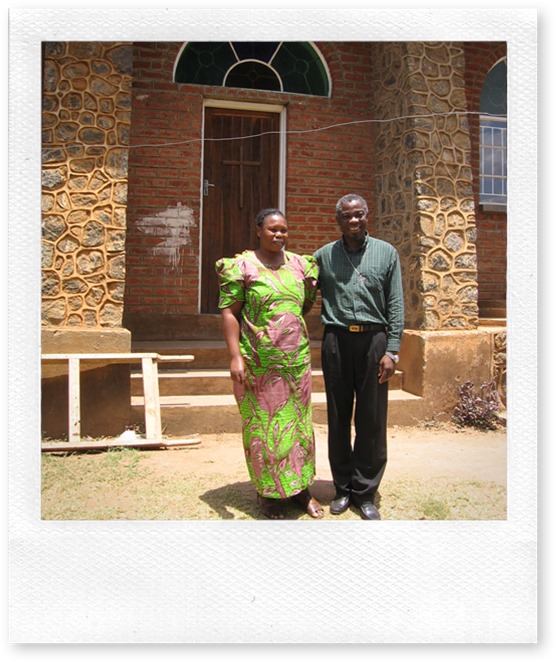
Photo of an Anglican pastor in Liongwe, Malawi by khym54, used under a Creative Commons License.

June 30, 2013

Sunday Afternoon Prayer: All Things Bright and Beautiful

Lake Michigan from a trail along one of the dunes
 at Nordhouse Dunes National Wilderness Area
I did a lot of thinking while I was in the woods this weekend. Besides my gratefulness to my mom, I thought about this hymn, "All Things Bright and Beautiful," a lot. When I got home I looked it up and discovered: "Cecil F. Alexander (PHH 346) wrote a number of hymn texts on articles of the Apostles' Creed. This text, whose biblical source is Genesis 1:31 ("and God saw all that he had made, and it was very good"), is Alexander's explanation of the Creed's phrase "Maker of heaven and earth" (Psalter Hymnal Handbook, from hymnary.org).
This afternoon, may we raise our voices to praise the maker of heaven and earth.

Refrain:
All things bright and beautiful,
all creatures great and small,
all things wise and wonderful,
the Lord God made them all.


1 Each little flower that opens,
each little bird that sings,
he made their glowing colours,
he made their tiny wings: Refrain

2 The purple-headed mountain,
the river running by,
the sunset, and the morning
that brightens up the sky: Refrain


3 The cold wind in the winter,
the pleasant summer sun,
the ripe fruits in the garden,
he made them every one. Refrain


4 He gave us eyes to see them,
and lips that we might tell
how great is God Almighty,
who has made all things well. Refrain

Source: Church Hymnary, Fourth Edition #137a


Personal Photo, June 2013

June 19, 2013

On Sacred Rhythms

Life has rhythms.  The rhythm of leaves budding, growing, coloring, and dropping.  The rhythm of people growing up, leaving home, marrying, having children, raising children, retiring, and dying.  The rhythm of the sun coming up and sun going down. 

And the spiritual life has rhythms, too.  The rhythm of advent, Christmas, Lent, Easter, Pentecost, and ordinary time.  The rhythm of baptism, profession of faith, serving the church.  The rhythm of prayer and Bible reflection. 

Ruth Haley Barton wrote a book called Sacred Rhythms: Arranging Our Lives for Spiritual TransformationIt is a book about what are classically called spiritual disciplines.  We might also call them spiritual practices or spiritual rhythms.  They are the practices that give a rhythm to our spiritual life.  Sometimes that rhythm is imperceptible, or we wish that we had a faster rhythm.  But even when we’d choose a different rhythm, God works through them.

Another one of my favorite books about spiritual practices is called Flunking SainthoodThe author, Jana Riess spent a year focusing on a variety of spiritual practices.  She starts the year as a “lighthearted effort to read spiritual classics while attempting a year of faith-related disciplines like fasting, Sabbath keeping, chanting, and the Jesus Prayer” (pg. ix).  Each month she picks a discipline, reads some spiritual classics related to that discipline and attempts to practice it.  And she struggles, even fails, with all twelve. 


After a few months and a significant life experience, she found that “Although I didn’t see it while I was doing the practices themselves or even while I was writing the chapters in this book, the power of spiritual practice is that it forges you stealthily, as you entertain angels unawares” (Flunking Sainthood, pg. 168).  God used both her attempts at these different practices, and even the process of failing, to shape her to become more Christ-like and more able to reflect Christ to the world.  She, like thousands of Christians before her, discovered the power of spiritual practices, sacred rhythms, to shape Christian life.

Growing up, I don’t remember hearing about spiritual disciplines or spiritual practices as a group or term.  And yet, we had plenty of them.  We read Bible story books or other devotional material after dinner.  My dad sang to us before we went to sleep.  We went to church twice on Sunday.  My parents taught me to tithe.  We took an extended family spring break trip to do hurricane relief in South Carolina.  There were Christian rhythms in our life.  They shaped my Christian life and how I practice my faith. 


As I grew up, some of my rhythms have developed and changed. They have shaped the rhythms of my life as a single woman.  Like Riess, I have certainly failed some.  Over the summer, I’m going to be reflecting on some spiritual practices that have been important in my life, or that I would like to experiment with.  I have plans to explore writing prayers, meeting with a spiritual director, keeping the Sabbath, and doing justice, among others.  I hope that I, and my readers, will learn new rhythms and that those rhythms would shape us to become more Christ-like.  

Drum picture by Martha Riley, used under a Creative Commons License.
Praying hands picture by C Jill Reed, used under a Creative Commons License.

May 10, 2013

Easter Chives


We are coming into the end of the Easter season—this Sunday is Ascension Sunday, the last Sunday of Easter.  During the last five weeks the church has been celebrating the resurrection and the new life that we have because of the death and resurrection of Christ.  I love Easterseason.  We didn’t celebrate it in the churches I grew up in.  We just got the glory of Easter’s morning and evening service.  Then things became rather non-descript until 40 days later, Ascension Day comes along.

At Church of the Servant, we celebrate Easter for the whole season.  Our art is white and gold and full of joy.  I get to wear my white stole.  We sing hymns about the resurrection and its impact on our life.  It is all about new life from death.  We were dead to sin but alive in Christ (Romans 6:11). 

I was reminded of this miracle by the neglected pots on my balcony.  I neglected them last fall.  I just let the plants die.  I never cleaned the pots.  They have been there, brown and shriveled for months and months.  I was dreading cleaning it all up and considering not planting anything this summer.

A couple of weeks ago we got rain and more rain and more rain.  Some of it managed to get onto my covered balcony and into at least one of the pots.  The weather slowly warmed past the freezing mark.  And I noticed something remarkable.  There was a dash of green sprouting from those shriveled dead leaves.  The chives that I grew last summer had come back to life.  It was a little resurrection. 

That bright burst of green coming up gave me hope.  It reminded me that my God says, “See, I am doing a new thing! / Now it springs up; do you not perceive it? / I am making a way in the wilderness / and streams in the wasteland” (Isaiah 43:19).  I don’t know exactly what new things God is doing and will do in my life. I do know that God is doing a new thing.  Just like my Easter chives.

Personal photo of my Easter chives, May 2013.

May 03, 2013

Singleness is Sanctifying, Too


I’ve often heard that marriage is sanctification.  Sanctification is the theological word for becoming holy or becoming like Christ.  In a good marriage, people learn about themselves and getting along with others.  There is no denying God uses marriage to help people grow in their faith and become more Christ-like.  The problem is that every time we say this, it implies that you can’t really be sanctified if you aren’t married.  It reinforces the notion that serving God as a married person is better than serving God as a single person. 

Sanctification does not require marriage.  There are many ways that God sanctifies us.  Even more, marriage is not necessarily a better or quicker way to sanctification.  In fact, singleness can be part of sanctification, too.  Being single is a different training ground, but I truly believe it too can be fertile soil for becoming Christ-like.    


 One area of fertile soil is identity and trust.  Without another person, I am forced to deepen my identity in Christ.  I am not tempted to think that my boyfriend or husband is able to complete me.  I am who I am not because of my relationship status or who I am connected to.  I am a baptized daughter of God.  This is true of all of us who are in Christ, but being single takes away a temptation to find identity elsewhere. 

I have learned to trust God in different ways than if I was married.  I don’t have another person to rely on.  If I don’t have a job, there is no one else to support me.  If I have a stressful meeting, no one is waiting at home to comfort me.  If I need to make a decision, there is no one to help make the decision.  Instead, I live by faith.  I am learning to trust that God will provide for my needs.  I am learning to trust that God hears my prayers and binds up my broken heart.  I am learning to trust that God leads me and guides me in decision making.  Being single is fertile soil for sanctification in trust.     

This might sound counter-intuitive, but I have found being single to be a place to learn about community and hospitality.  You have to be intentional about developing community, when you don’t have built-in community with your spouse (although I would argue you still need to develop community with others when you’re married).  It takes work to maintain relationships.  There’s a learning curve to relationships—I have had to learn how to be vulnerable and let others in.  But those relationships can be sweet, friends that are family.  They are a community that has walked through some dark valleys, empty desserts, and sun-filled meadows with me.  I am better at all of the one-anothers we find in scripture because of this community.
 
The really awesome empty tomb cake my mom made for our Easter celebration!
Being single is also an opportunity to offer hospitality to others.  Before even offering hospitality, being single has given me a different insight into what it is like to be at the margins.  I don’t fit into what society expects, and it has made me more conscious of other people who might be feeling a bit out of place.  I want my life to be one that welcomes people in and gives them a place to feel at home.  What I desire to offer isn’t the stereotype of hospitality: dinner parties for couples or huge family dinners.  There is freedom associated with singleness and the type of hospitality I can offer.  I don’t have to figure out which family I’m going to spend holidays with.  This year, my parents came to celebrate Thanksgiving at my apartment with some of the refugees I work with.  At Easter, I took a family to my parents’ house for dinner.  I still have lots to learn (sanctification is a process, after all), but it is definitely a way that God is forming me.   

Getting married is not the only way to become sanctified.  There are plenty of sanctifying experiences and situations that come along with being single.  And so for all of us—whether married or single—my prayer is that we will “grow in every way more and more like Christ, who is the head of his body, the church” (Ephesians 4:15, NLT).


Personal photos taken on Iona, Scotland and at my parents' house in Michigan, taken in January and March 2013.

April 07, 2013

Sunday Afternoon Prayer: A Prayer for the Year to Come


I'm continuing the birthday theme for one last post (previous here and here), with my prayer for the coming year of my life.


Thank you for your faithfulness in the past year,
For grace in difficult situations,
For growth as a pastor
For relationships that have supported me.

And in this year to come, may I be a person of
Strength,
Joy,
Stability, and
Hospitality.

May I grow in my
relationship with you,
prayer life,
memorized scripture, and
identity in Christ.

May I live in community with friends
Near,
Far,
Old, and
New.

May I serve you
Faithfully,
With wisdom,
With self-less love for others, and
Wherever you call me.

May I be filled with joy
Exploring your creation,
Creating beautiful things,
Laughing with friends,
And trying new things.

Whether in word or in deed,
Be done in the name of Jesus.

In Jesus’ name.  Amen.


Personal photo taken in the Iona Abbey, Iona, Scotland, January 2013. 


January 20, 2013

UK #11: Two Different Churches in York


After Edinburgh, I headed south, back to England.  My destination was the ancient city of York.  York is strategically placed where two rivers meet.  The Romans built a fort here in 71AD.  Constantine was in York when his father died, and he was crowned emperor in York.  
Ruins of a tower of the Roman city

In the 600s, the Pope sent a bishop to York, Britain's second bishop.  During the next several hundred years, Christianity grew and many churches were built in York.  Then the Vikings invaded and settled in York.  Eventually the surrounding Anglo-Saxon kings defeated the Vikings, but then 1066 came, and Britain was defeated by William the Conqueror.  By 1070, William appointed a Norman Archbishop of York, who began to build a large church.  In the middle ages, they used the Norman foundations of the church to build the York Minster over the course of 250 years.  They also started St. Mary's Abbey with French monks.  This was dissolved by Henry VIII when he split with the Roman Catholic Church. 
Me (at a strange angle) with the ruins of the abbey church behind me


 York has a long and interesting history with many interesting historic sites, with the most magnificent being the York Minster.
York Minster

The York Minster is BEAUTIFUL.  Words can't describe it. My point-and-shoot camera was pretty inadequate, too.  The building was built in phases over hundreds of years--generations of craftsmen spent parts of their life working on this building.  Their goal was to bring heaven to earth in this building.  While we don't know exactly what heaven will be like, I think that we last least get a glimpse in a building like this.
Interior of York Minster

The York Minster is still a working church. The tour guide said that their Sunday Services are still fairly well attended and they have programs for children.  They also have daily services.  I wasn't in York on a Sunday, so I went to a weekday Evensong service, which comes at the end of the work day.  Much of it is sung by the Minster choir. It is a liturgical service of prayers and sung and spoken scripture.  York Minster is an Anglo-Catholic Church of England church, which basically means they are as close to Roman Catholic practice as you get on the Protestant continuum. 

At the service I attended, there were plenty of tourists, who were very obvious because they weren't following the order of service by closely (one of the people in front of me gave me a strange look when started to say the creed).  But there were also people who belonged.  Mothers with kids in school uniforms carrying instrument cases like they were on their way to or from lessons.  The worship and the prayers were very heartfelt.  It was a very formal setting, which gave a sense that this is true and important, but it was also living.  God is here.  And God has been caring for his church for centuries.

York is a city full of churches.  These days, there are plenty of empty ones that aren't used as churches any more.  But right next to the Minster is a smaller church that is in active, thriving use.  It is called St. Michael Le Belfrey.  It is also a Church of England, but from the evangelical/revival stream, more like St. Mary's in Poole.  In fact, it was an early leader in this movement of church revitalization in the 1960s and 70s.  The story of those days is told by the pastor at that time, David Watson, in the book You Are My God (out of print, but I read it from the Calvin library).

St. Michael Le Belfrey Sign

Today they are still a vibrant church with a number of different services.  I went to their Wednesday noontime service.  Because it is winter, it was held in their church hall, not the church building itself.  It was about 50 people, mostly retired folks, it seemed.  It was a simple service--a song, a prayer, scripture reading, and teaching sermon.  There was a lunch after the service.  It was obvious people knew and cared for each other.

One thing that struck me was that the leaders made sure to explain things as we went.  They didn't assume that everyone had been Christians their whole life.  And the gentlemen that sat next to me, that I was able to chat with for a few minutes said he had only been a Christian a year and a half.  He said he is still learning new things all the time.  Thinking about this, it is probably more welcoming for someone who is a bit older when they consider Christianity to come into a place where people don't assume you know things because you have been a Christian all your life.  I think this is a challenge for us in the CRC and West Michigan in particular, because the vast majority of people in our churches 60+ have been Christians all their lives and probably went through Christian schools.  They are fairly well-educated in Christianity.  How do we make space for their colleagues and neighbors who didn't grow up in the church or left it long ago?  

In most of the evangelistic/renewal churches I have visited, there is careful attention to making sure things are explained so people with less church background can join in.  Even simple things, like after announcing that the reading is from the book of James, saying "that's near the end of the New Testament" to help people locate it in their Bibles.  When I attended Monroe Community Church, a CRC church plant at that time, the pastors were pretty conscious of this.  They always introduced themselves when they got up and introduced the way we did things.  Sure, those of us who were regulars didn't need to be told that we could get up and get a Bible from the table by the pole, but it made space for the visitors among us.  In a way, it says that our borders are open, we,re prepared to welcome new people in.  It seems that many established churches are less conscious of this--we just do what we do.  I think that we have things to learn from the British church about how to present Christianity and the church to people without any background in it, and that number is rapidly increasing in our society.