Showing posts with label justice. Show all posts

November 26, 2013

Advent Calendar Printable

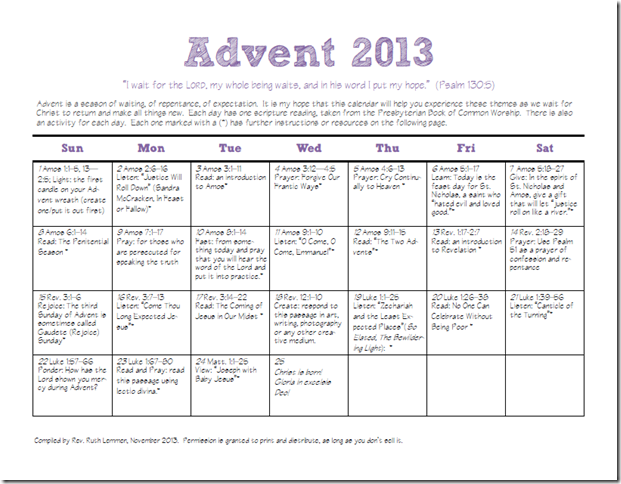
This coming Sunday, December 1, is the first week of Advent.  Advent might be my favorite season of the church year—you can look forward to a number of Advent themed posts in the coming weeks.  It is a time of expectant waiting.
A few weeks ago, my sister wrote to me and asked if I had any suggestions for Advent calendars.  She wanted to make one, but wasn’t sure of what activities to put on it that a) weren’t geared for kids and b) had some spiritual significance.  I did a tiny bit of internet browsing and couldn’t come up with anything that was workable, either. So I decided to create my own.  I assigned one scripture for each day and then an activity.  The activities vary and are at least loosely connected to the scripture.  Some samples: listening to “Zechariah and the Least Expected Places,” using Psalm 51 as a prayer of confession, choosing something joyful to do, and reading a passage with lectio divina (instructions included).  Although this isn’t written specifically with children in mind, I think you could easily use it with older children and teenagers.   advent calendar
I enjoyed putting this together, and I’m looking forward to using it myself.  If you are looking for something to guide your reflection during Advent and help you engage the themes of Advent—and the God who came in the flesh and will come again—please feel free to use it, too.  It is available as a free printable.  You are free to print and distribute this, but I do ask that you don’t sell it—I’m making it available for free and would like to keep it that way.  Have a blessed Advent!  

July 28, 2013

Sunday Afternoon Prayers: For a Bittersweet Day

Today is bittersweet.  It was my last Sunday morning with my congregation.  I am so thankful for these two years, and it is so hard to say goodbye.  And so today I offer two prayers.  Both of these prayers originate in Africa and came to me in An African Prayer Book.


My prayer of thanksgiving, for the people I have had the opportunity to know from around the world and for the ways that they have shown that church can be like a big family.

Our Churches Are Like Big Families

Lord, we thank you that our churches are like big families.
Lord, let your spirit of reconciliation blow over all the earth.
Let Christians live in your love.
Lord, we praise you in Europe's cathedrals, in America's offerings, 
And in our African songs of praise.
Lord, we thank you that we have brothers and sisters in all the world.
Be with them that make peace.
Amen. (West Africa, pg. 65-66).

And my prayer for the people that I am leaving, that God will continue to be at work in and through them and will continue to hold them in the palm of his hand.

The Privilege Is Ours To Share In the Loving

Almighty God, our heavenly Father, the privilege is ours to share in the loving, healing, reconciling mission of your Son Jesus Christ, our Lord, in this age and wherever we are.  Since without you we can do no good thing.
     May your Spirit make us wise;
     May your Spirit guide us;
     May your Spirit renew us;
     May your Spirit strengthen us;
So that we will be:
     Strong in faith,
     Discerning in proclamation,
     Courageous in witness,
     Persistent in good deeds.
This we ask through the name of the Father.
(Church of the Province of the West Indies, pg. 96-97)


Prayers from An African Prayerbook, selected and with an introduction by Desmond Tutu, Image/Doubleday books, 1995.
Photo by John Flanigan, http://www.flickr.com/photos/82369865@N00/5414528258/in/photolist-9fsSBu, used under a Creative Commons License

June 19, 2013

On Sacred Rhythms

Life has rhythms.  The rhythm of leaves budding, growing, coloring, and dropping.  The rhythm of people growing up, leaving home, marrying, having children, raising children, retiring, and dying.  The rhythm of the sun coming up and sun going down. 

And the spiritual life has rhythms, too.  The rhythm of advent, Christmas, Lent, Easter, Pentecost, and ordinary time.  The rhythm of baptism, profession of faith, serving the church.  The rhythm of prayer and Bible reflection. 

Ruth Haley Barton wrote a book called Sacred Rhythms: Arranging Our Lives for Spiritual TransformationIt is a book about what are classically called spiritual disciplines.  We might also call them spiritual practices or spiritual rhythms.  They are the practices that give a rhythm to our spiritual life.  Sometimes that rhythm is imperceptible, or we wish that we had a faster rhythm.  But even when we’d choose a different rhythm, God works through them.

Another one of my favorite books about spiritual practices is called Flunking SainthoodThe author, Jana Riess spent a year focusing on a variety of spiritual practices.  She starts the year as a “lighthearted effort to read spiritual classics while attempting a year of faith-related disciplines like fasting, Sabbath keeping, chanting, and the Jesus Prayer” (pg. ix).  Each month she picks a discipline, reads some spiritual classics related to that discipline and attempts to practice it.  And she struggles, even fails, with all twelve. 


After a few months and a significant life experience, she found that “Although I didn’t see it while I was doing the practices themselves or even while I was writing the chapters in this book, the power of spiritual practice is that it forges you stealthily, as you entertain angels unawares” (Flunking Sainthood, pg. 168).  God used both her attempts at these different practices, and even the process of failing, to shape her to become more Christ-like and more able to reflect Christ to the world.  She, like thousands of Christians before her, discovered the power of spiritual practices, sacred rhythms, to shape Christian life.

Growing up, I don’t remember hearing about spiritual disciplines or spiritual practices as a group or term.  And yet, we had plenty of them.  We read Bible story books or other devotional material after dinner.  My dad sang to us before we went to sleep.  We went to church twice on Sunday.  My parents taught me to tithe.  We took an extended family spring break trip to do hurricane relief in South Carolina.  There were Christian rhythms in our life.  They shaped my Christian life and how I practice my faith. 


As I grew up, some of my rhythms have developed and changed. They have shaped the rhythms of my life as a single woman.  Like Riess, I have certainly failed some.  Over the summer, I’m going to be reflecting on some spiritual practices that have been important in my life, or that I would like to experiment with.  I have plans to explore writing prayers, meeting with a spiritual director, keeping the Sabbath, and doing justice, among others.  I hope that I, and my readers, will learn new rhythms and that those rhythms would shape us to become more Christ-like.  

Drum picture by Martha Riley, used under a Creative Commons License.
Praying hands picture by C Jill Reed, used under a Creative Commons License.

May 14, 2013

Grains of Hope

“We have, what do you call it, a small bit of wheat at the end of stalk, a grain.  We have what you would call, grains of hope.  When I face, when I am in darkness, even there when I am beaten and tortured every day, I have hope.  I do not stop.  That is what keep me alive.” 

These words came from the lips of a man who came as a refugee to Grand Rapids, and they became the title of the play Grains of Hope.  Grains of Hope is an ethnographic play created by Stephanie Sandberg and the Calvin Theater Company.  Stephanie and Calvin students interviewed over 100 people in West Michigan who came here as refugees or work closely with refugees.  From those interviews, she chose 7 stories—7 people—to feature at the center of the play.   An 18 year old woman who came to Grand Rapids from Vietnam with her family when she was three years old.  A man who fled Sudan as a child and when he eventually came to Grand Rapids, all he knew of America was Mickey Mouse printed on a t-shirt.  A Bhutanese man who spent 15 years of his life living in a refugee camp in Nepal in a simple bamboo house with dirt floors.  In the play, actors brought each of these characters to life using their own words from the interviews.  

They told of how they came to be in Grand Rapids and what they have faced since they arrived.  Stories of the difficulties of learning English and finding work.  They told stories of struggles to find good and affordable housing.  And they told stories of friendship and the people who have helped them along the way--middle school teachers, caseworkers, and doctors, an English tutor who became a friend, an older woman who became a family’s adopted mother and grandmother.

This play was performed 13 times in various locations around Grand Rapids over the last few weeks.  My congregation was privileged to host one of the performances last Sunday evening.  We have been active in working with refugees for many years, and several of the people who appeared in the play were members of our church who have developed relationships with families who came as refugees.  It was moving to see their dedication over the years brought to life. 
An actress telling the story of a woman who came from the DR Congo
As I watched the play, there were points where I was almost in tears at the stories.  Even the people who I don’t know personally have elements of their stories that are similar to stories I have heard from people that I know.  These are people that have welcomed me into their homes with various kinds of chai, fruit, and other snacks.  Who seem glad to have me there, even if much of the conversation around me is in a language that I don’t understand.  Who have loved me and prayed for my mom when she had surgery last winter.  They are people who have come through horrific circumstances to a new life in America.  And that life isn’t necessarily easier—safer and with a higher material standard of living, perhaps—but with the new challenges of DHS who cuts benefits (like food stamps) if you miss a letter or appointment, a mind-bogglingly complex medical system, and a culture that is independent to the extreme. 

I am so inspired by the people I know who arrived here as refugees.  I have seen Christ in them, again and again.  I am thankful for the opportunity to get to know so many of them in the past few years.  I have seen their hope, even in midst of despair.  I hope some of that has rubbed off on me.  And I hope that I and churches across North America would offer the friendship that gives hope to dealing with the transitions.  I pray that we would reflect Christ to our friends, because Jesus is the source of true hope.


Resources:


Wheat photo by Marilylle Soveran, http://www.flickr.com/photos/86953562@N00/47812279/, used under a Creative Commons License.
Play photo from Calvin College publicity, http://www.calvin.edu/news/archive/grains-of-hope
January 12, 2013

UK #7: The Iona Community

Iona Abbey
One of the reasons the Isle of Iona has contemporary significance and is well-known in some Christian circles is the Iona Community. I think in North America we sometimes think of them as being the whole island, but they are not. In fact they share the abbey with Historic Scotland who cares for and manages the site. 

In the 1930s, in the midst of the Great Depression, a pastor named George MacLeod came up with the idea to restore the abbey using unemployed craftsmen and young pastors (so they would have training before they went to urban missions). In addition to their construction work, they practiced living in community. Today the Iona Community is "an ecumenical Christian community of men and women engaged together, and with people of goodwill across the world, in acting, reflecting,and praying for justice, peace and the integrity of creation; convinced that the inclusive community we seek must be embodied in the community we practice." It is a sort of untraditional monastic order. Members commit to live by a shared rule which includes daily prayer and Bible reading, mutual accountability for use of time and money, meeting together, and action for justice and peace. There are about 300 members, mostly in Britain. They are divided into geographical family groups. There are also 1450 associate members and 1250 friends scattered across the world "from Michigan to Malawi." 

The abbey on Iona serves as a sort of base. There is a core group of resident staff, and from March to October they offer week-long experience of living in community for people from around the world. They also maintain daily worship at the abbey, which is open to the public. I joined in a couple of their morning prayer services while I was on the island. They were small, quiet gatherings with a few songs, prayers of confession and intercession, and a scripture reading. Each day in their intercessory prayer, they pray for specific countries, specific needs, and specific members of the community (on a cycle that all members follow). 
Chapel where worship is held in the winter

 Before coming, I was probably most familiar with the Iona Community's publishing and especially liturgical resources. I think that is probably what has made the biggest worldwide impact. We have used some of their liturgies at ÇOS (an excerpt I shared). Many songs we sing regularly come through the Wild Goose Resource Group: "He Came Down, " "Take, O Take Me As I Am," "Your Will Be Done On Earth," "Come Now, O Prince of Peace," "Come All You People" and more. 

 What I knew less about was the Community's commitment to advocate for social justice and peace. In the Abbey church, they have some displays about different justice issues. Their shop is completely fair trade (much of it local). It was a great place to do a bit of shopping. I am not exactly sure what this commitment looks like in the everyday life of a member, but I would be curious to find out some day. Looking at this ancient building and place and seeing Christians confront modern problems and experiences is inspiring. Throughout my trip so far, I have noticed that trend--communities breathing new life into old places and practices without demolishing the old. 
Displays on social justice issues
I am fascinated by the idea of living in community, while not actually living together. Things like their rule bind them together, but they can actually be spread apart. I wonder what this could look like in other situations. I am thinking especially of pastor-types who make friends and have community, but move often. This question of how to have community when people keep moving or getting married and moving, knowing there is a good chance I'll be moving this summer has been on my mind in the past few months.
St. John's cross (modern replica)
 I wonder if we could create a community for ourselves based not on living near each other, but on a rule that we would create and a commitment that we would continue to support each other. I think our rule would look a bit different than the Iona Community, but I think it could work. I would be interested to try.

November 25, 2012

Sunday Afternoon Prayer: A Grace

I found this simple yet profound prayer this week:
O God,
To those who have hunger give bread,
To those who have bread
Give hunger for justice.

From South America, found in Around a Thin Place: An Iona Pilgrimage Guide by Jane Bentley and Neil Paynter, pg. 77