Showing posts with label discipleship. Show all posts

January 05, 2014

Sunday Afternoon Prayer: Give Us the Attentiveness of the Wise Men

“Where is the newborn king of the Jews? We saw his star as it rose, and we have come to worship him.” 
--Matthew 2:2, NLT
Tomorrow is Epiphany in the church calendar, when the church traditionally remembers the arrival of the wise men to worship Jesus.  In that tradition I offer this prayer inspired by their worship.

IMG_5007Almighty God who took on infant flesh,
you were worshipped by shepherds and wise men,
people who searched for you with passion,
all to worship Jesus.

Give us the attentiveness of the wise men,
who noticed the oddity in the sky,
and followed it,
all to worship Jesus.

Give us the perseverance of the wise men,
who travelled from a far off land,
through deserts and dangers,
all to worship Jesus.

Give us the generosity of the wise men,
who brought costly gifts,
fit for a dying king,
all to worship Jesus.

Give us the joy of the wise men,
who rejoiced when they arrived in Bethlehem,
finally reaching their goal,
all to worship Jesus.

May we worship you,
with attentiveness,
with perseverance,
with generosity,
and with joy.
In Jesus' name.  Amen.

Personal photo (of a nativity scene I made), January 2014.

January 02, 2014

When Christmas Isn’t Tinselly

76567867_ea268e2793_oMaybe your first thought when you saw that the title of this post includes the word Christmas was “how behind is she?”  I do know that in the wider culture (and even sometimes in our churches), Christmas has come and gone.  New Years Eve and New Years Day has come and gone.  Store holiday sections are now anticipating Valentines Day.  But hear me out: I’m living into the church calendar and continuing to contemplate the miracle of the incarnation during this Christmas season (which lasts 12 days until January 6).  After the expectation and longings of Advent, we get more than one day for Christmas.  In the church calendar, the color of Christmas is white, a color of joy and celebration.  In American culture, which generally skips Advent, we get a whole month to be be happy and glowing and full of good cheer.  But the incarnation isn’t really a tinselly affair.  It is messy, gritty, painful. 


I’ve been listening to Handel’s Messiah during Advent and Christmas.  One song that stuck out to me takes its text from Isaiah 53:4-5: “Surely He hath borne our griefs, and carried our sorrows! He was wounded for our transgressions, He was bruised for our iniquities; the chastisement of our peace was upon Him.”  This verse is often used during Lent, but it seemed so right to think about this verse during Christmas.  Jesus took on flesh and moved into our neighborhood (see John 1 in The Message) as a tiny, helpless baby.  And Jesus grew up; he lived a human life and faced its trials and uncertainties without sin.  Hebrews tells us that Jesus can empathize with our every weakness.  Jesus bears our griefs and carries our sorrows.

This is what Christmas is all about.  Jesus, the second person of the Trinity, took on flesh.  Through the Holy Spirit, Jesus walks with us.  He knows our pain.  He carries our sorrows.  He doesn’t take them away.  In this already-but-not-yet time we still face the troubles of this world.  But we don’t face them alone.  We face them with our merciful Savior who suffered the indignity to be born into this mess.

This has been a hard holiday season for me.  I identify with the themes of Advent—the waiting, the longing, the expectation—much more than the joy and peace of Christmas.  When I heard the chorus singing “surely he hath borne our griefs and carried our sorrows” as I sat alone in my room, grieving this season of my life, I heard the Christmas story in a new way.  It isn’t just a “silent night, holy night.”  Christmas is pain and joy mixed together.  The joy of a child born mixed with the pain of childbirth, Mary and Joseph’s tenuous social position, and the humiliation of God taking on flesh.  The joy of Simeon seeing salvation and finding peace to depart this earth along with his prophecy that a sword would pierce Mary’s soul, too (Luke 2:25-35).  Jesus knows my pain and carries my sorrows.  I am not alone in my grief, but my grief is known by my loving God.

Perhaps this has been a hard season for you, too.  If so, I pray that you will know the presence of Emmanuel, our God-with-us, our God who took on flesh and moved into our neighborhood.  May God comfort you with the knowledge that Jesus carries your griefs and your sorrows, whether they are public or known to God alone.  May you see a glimpse of Christ’s light, shinning in the darkness. 

Photo by Jim Kenefick, used under a Creative Commons License

December 05, 2013

Boxing Lament, Creating Playlists, and Backwards Parties: Spiritual Practices for a Busy Generation

I was talking with a clergy colleague/friend recently about an intergenerational study she is putting together for her congregation about spiritual disciplines.  We talks a bit about the different resources she is (and could) pull from.  There are a number of books about spiritual disciplines published.  I had never heard the term “spiritual discipline” until I was in college.  I was introduced to the term and the concept through Richard Foster’s Celebration of DisciplineMy family and church community had certainly practiced spiritual disciplines (some better than others), but I had never seen them all laid out and talked about as a whole. 
51m rLUW5kL._BO2,204,203,200_PIsitb-sticker-arrow-click,TopRight,35,-76_AA278_PIkin4,BottomRight,-66,22_AA300_SH20_OU01_In the years since, I have read a number of such books at different points in my life.  Each has a slightly different tone and focus.  Most recently I read Who’s Got Time: Spirituality for a Busy Generation by Teri Peterson and Amy FettermanIt is one of the newest titles in the Young Clergy Woman Project imprint with Chalice Press.  Peterson and Fetterman are both youngish pastors and they wrote this primarily for people in their generation.  People who grew up with computers.  People who grew up moving frequently and far from extended family.  People who are marrying later and later or not marrying at all.  People who struggle to find work and if they do expect to change jobs regularly for the rest of their life.
Peterson and Fetterman do a great job of suggesting ways to practice spiritual disciplines (both classic and new) in the busy, hyper-connected life most of us live.  I really appreciated their practicality and creativity.  As much as a I respect Foster’s work, Celebration of Discipline doesn’t include a chapter on social media. 
Here’s a sampling of some of the ideas that I found interesting (they cover more traditional disciplines, like fasting, too).  Chapter two is called “In the Body,” and it explores “ways we can exercise our spirits as we live in flesh and bone.”  One of their suggestions is to incorporate a piece of scripture into a boxing (or kickboxing?) routine.  They say “Amy’s personal favorite combo includes Psalm 61:1 and goes like this: Hear *jab* my *jab* cry *right hook* O *left hook* God *backfist*.”  I may or may not actually try this one myself, but a physical lament sounds awesome!
Chapter four is all about using music in the life of faith.  One of my favorite ideas from the chapter I already shared on the blog—making playlists.  They suggest peace and righteous anger playlists.  I made a wait. hope. expect. playlist that helps me to wait with hope during this period of my life.
They also have a chapter on rituals that I found inspiring.  They wonder “How do we organize our hopes, dreams, fears, realities, loves, losses, and find a sense of the Holy in the midst of them? How do we mark these life events that don’t have rituals already attached to them the way marriage or kids do?…We believe there is a way to create ritual that makes meaning out of the lives we live now, as twenty-first–century young adults” (ch. 5).  One of the examples they give is a “backwards party” when one of their friends was moving away.  They started by saying goodbye, ate dessert, then dinner, and ended with saying hello.  It was a ritual that helped this group of friends to transition to a new phase of their friendship.  I haven’t started any new rituals yet, but I’m thinking of opportunities.
There are lots more ideas in the book, and I would encourage you to check it out for yourself if you are looking to grow in your spiritual walk.  I would add a note that I am a bit more conservative in theology than the authors, and a few ideas I’m not sure I’d be comfortable trying.  But that doesn’t mean they don’t have lots of good ideas and true thoughts.  

December 01, 2013

Sunday Afternoon Prayer: When The Timing Seems Wrong

Today is the first Sunday of Advent, a time of waiting and anticipation.  This is my prayer for these weeks (and my life).  If you are looking for devotional activities for Advent, you can print what I created.  If you are still thinking about American Thanksgiving, you can read about things I'm thankful for.

God of time,
You are outside of time.  Yet you created time. 
That time plays a big part of lives.  And sometimes, the timing just seems wrong. 
The Israelite people wanted their Messiah to come sooner to rescue them.
Zechariah and Elizabeth longed for a child to be born for years.
Mary faced a too-soon-pregnancy.
Christians have been waiting for Jesus to return.  For 2,000 years.
Some wait for a positive pregnancy test while others are overwhelmed with an unexpected pregnancy.
We wait to hear back about job interviews and scholarships, home sales and medical tests.
So often, the timing just seems wrong and our lives feel like they are crumbling.

How long, O Lord?

How long until you make “beautiful things out of dust”?
4304758723_0cb22b43e5_o
Jesus, you know time.  You too had to wait until your hour came.
Help us as we wait!  Give us strength and patience. 
Help us to trust in your timing, that you are caring for us even when it seems like our lives are dust.
Help us to see glimpses of “hope…springing up from this old ground.”
In the name of the Father, Son, and Holy Spirit.  Amen.

With thanks to Psalm 13, Luke 1-2, John 2, and “Beautiful Things” by Gungor.  
Photo by gilliu00_, used under a Creative Commons License. 


November 26, 2013

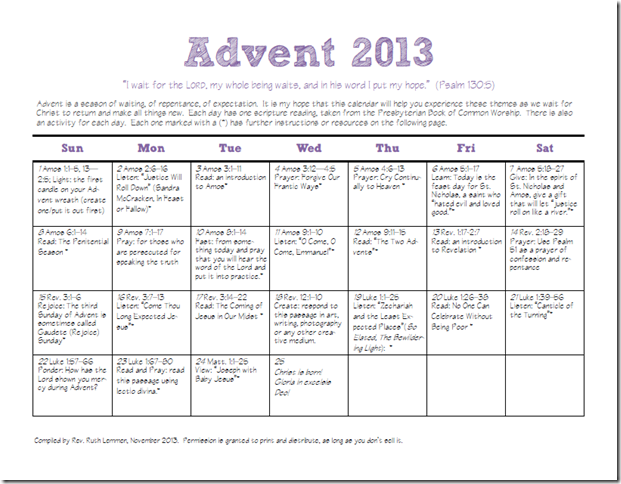
Advent Calendar Printable

This coming Sunday, December 1, is the first week of Advent.  Advent might be my favorite season of the church year—you can look forward to a number of Advent themed posts in the coming weeks.  It is a time of expectant waiting.
A few weeks ago, my sister wrote to me and asked if I had any suggestions for Advent calendars.  She wanted to make one, but wasn’t sure of what activities to put on it that a) weren’t geared for kids and b) had some spiritual significance.  I did a tiny bit of internet browsing and couldn’t come up with anything that was workable, either. So I decided to create my own.  I assigned one scripture for each day and then an activity.  The activities vary and are at least loosely connected to the scripture.  Some samples: listening to “Zechariah and the Least Expected Places,” using Psalm 51 as a prayer of confession, choosing something joyful to do, and reading a passage with lectio divina (instructions included).  Although this isn’t written specifically with children in mind, I think you could easily use it with older children and teenagers.   advent calendar
I enjoyed putting this together, and I’m looking forward to using it myself.  If you are looking for something to guide your reflection during Advent and help you engage the themes of Advent—and the God who came in the flesh and will come again—please feel free to use it, too.  It is available as a free printable.  You are free to print and distribute this, but I do ask that you don’t sell it—I’m making it available for free and would like to keep it that way.  Have a blessed Advent!  

August 18, 2013

Sunday Afternoon Prayer: Great is Thy Faithfulness

IMG_5535This weekend my family is celebrating my maternal grandfather’s 90th birthday.  My grandpa has been following Jesus for his whole life and would be the first to say that God has been faithful.  Life has not been without challenges, but God has been with Grandpa and used him to bless many people.

Loving and Faithful God,
For keeping a child of your covenant, baptized when he was an infant, safe in your hands,
Great is thy faithfulness.
For his parents who loved him and taught him about you,
Great is thy faithfulness.
For keeping Grandpa safe while he was deployed in the Navy,
Great is thy faithfulness.
For giving him a beautiful wife who loved him until her dying day,
Great is thy faithfulness.
For three children that he loved and supported (and is still very willing to help weed gardens or repair their homes),
Great is thy faithfulness.
For helping him to become a great teacher and principal,
Great is thy faithfulness.
For blessing him with grandchildren—both adopted and biological—that he loves deeply,
Great is thy faithfulness.
For saving his life from cancer,
Great is thy faithfulness.
For Grandpa and Grandma’s consistency at showing up at their grandkids events—church programs, piano recitals, sports games, etc.,
Great is thy faithfulness.
For the hours of volunteer service at Desert Christian High School, World Renew (formerly CRWRC) Disaster Response Services, Bibles for Mexico Thrift Stores, and other places,
Great is thy faithfulness.
For the love he shows his great-grandchildren through creating toys and babysitting,
Great is thy faithfulness.
For the love of and commitment to the church (there are few times I’ve heard him complain about it!) that he demonstrates to all of us,
Great is thy faithfulness.
For 90 years of following you,
Great is thy faithfulness.
Great is thy faithfulness! Great is thy faithfulness!
Morning by morning new mercies I see;
all I have needed thy hand hath provided.
Great is thy faithfulness, Lord, unto me!


Personal photo of my grandpa and me at my ordination, January 2012.

August 11, 2013

Sunday Afternoon Prayer: He Didn’t Know Where He Was Going


6532913915_266451fbe9_o


“By faith Abraham, when called to go to a place he would later receive as his inheritance, obeyed and went, even though he did not know where he was going.  By faith he made his home in the promised land like a stranger in a foreign country; he lived in tents, as did Isaac and Jacob, who were heirs with him of the same promise.  For he was looking forward to the city with foundations, whose architect and builder is God.  And by faith even Sarah, who was past childbearing age, was enabled to bear children because she considered him faithful who had made the promise.  And so from this one man, and he as good as dead, came descendants as numerous as the stars in the sky and as countless as the sand on the seashore” (Hebrews 11:8-12).


God of Abraham,

You called Abraham to a place, but you didn’t tell him where it was.

You asked him to make a leap of faith, to trust that you were faithful and had a plan.

You made crazy promises (descendants to an infertile couple?) to Abraham,

and you kept your promises.


Promise-keeping God,

I’m really holding on to the fact that you are faithful, because things look pretty confusing right now.

I’m trusting that you have called me to a place, but haven’t told me where it is yet.

I’m packing my boxes, trying to figure out what I’ll need if the waiting lasts 2 months, and what I’ll need if its 4 more months, or 6 months,

trusting that you have a plan for all of this.


Faithful God,

Give me the faith of Abraham, the faith to trust you to guide me to a place,

Give me the trust of Abraham to make my home in a temporary place,

Give me the patience to wait to see how you’ll work,

because I “consider him faithful who had made the promise.”

Amen.


Photo by Joana Bourne, used under a Creative Commons License.

August 01, 2013

Everything That Rises Must Converge

Two years ago this week, I started working at Church of the Servant.  I had just graduated from seminary a few months earlier and it was my first pastoral call.  I was nervous.  I wasn’t completely sure I would actually like being a pastor full-time.  And I wasn’t exactly sure what it meant that I was now a pastor.

Throughout seminary, I felt torn.  Before I went to seminary I taught English in China.  That had been an interest of mine since I was in high school.  I went to college with that in mind.  I was an English major and Chinese minor.  And I loved teaching English.  If I had chosen my life’s path I would have gotten an MA in TESOL (teaching English to Speakers of Other Languages).  Instead, God called me to seminary, to the world to theology, Biblical languages and studies, church history, and pastoral care.  And there were lots of moments that I felt lost and out of place.  I would hear people talking outside of class and have no idea who or what they were talking about.  I grew to enjoy seminary and had wonderful internships.  But I still felt like I had two parts.  I had the English teacher part of me and the pastor/seminarian part of me.  And they didn’t go together.

Then I started at COS where I became the primary pastor for the Basic English Service.  As I prepared sermons, I needed the skills I learned teaching English of explaining abstract or difficult concepts with simple words.  I needed the skills I learned in seminary of how to read a Biblical text well and understand what it is saying.  I needed the skill of speaking slowly naturally and articulating words carefully.  I needed the systematic theology I learned to help explain what Christians believe.  I needed all of the cross-cultural skills that I had developed.  I needed to know how to structure a sermon effectively. 
  
In this call, the English teacher part of me and the pastor part of me started to come together.  The threads of my life started to get pulled together into one strand instead of being separate.  My spiritual director shared a phrase with me, the title of a Flannery O’Connor short story, “everything that rises must converge.”  This has been true for me in the last two years.  Everything that had risen in my life converged, and I am so grateful.
320461_10152097141755012_336543183_nI am grateful for the opportunity to preach in this unusual environment and the ways that it has shaped my preaching.  Preaching regularly to a community has helped me form a rhythm of sermon preparation and become comfortable with preaching.  It is still always a little nerve-wracking somewhere in the process, but it also feels like this is what I do, because I am a pastor now.  And preaching in this unique service helped me to hone in on being clear and having one point in mind.  It helped me to think through what is most important in the given passage and leave lots of interesting but not essential information in the study.  It was a privilege to preach to many people that were hearing the story of the Bible for the first time, and I hope that I keep that in mind even if I am in a church where they are a lower percentage of the congregation.

I am grateful for the opportunity to work with the wonderful staff at COS.  They respected me as a colleague, encouraged me when things were difficult, modeled practices of Christian ministry, and loved me.  I learned a lot from spending time with them in the church kitchen and work room, listening in to conversations about the budget, handling pastoral situations, and picking curriculum for kids.  The high rate of turnover with residents is hard for the staff because they get attached to us and then two years are over and we leave, so I am especially thankful that they took the time to get to know me and allow me to learn so much.
IMG_2532I am grateful for the many cups of chai (both Nepalese and Sri Lankan versions) I drank in people’s homes.  I was welcomed into people’s homes with such gracious hospitality.  I don’t think I was ever told I couldn’t come, and it was a rare day when I wasn’t offered chai, or juice, or fruit.  Americans (and I am not an exception) are not that good at being hospitable to strangers.  I hope that I will be able to share some of the hospitality I received with others.  It was a privilege to be welcomed in to homes, to hear the stories of people in my congregation (most of whom were refugees), and walk alongside them in life.  I am thankful for their love and their prayers.
 
I am grateful for the strong volunteer base at COS.  Every program I worked with had strong volunteer leaders—people who dedicate hours of their time and energy to serving the church and community.  I’ll admit, sometimes this was frustrating and sometimes those leaders were frustrated with me.  But I am thankful for the relationships that formed and that we ended on a good note.  I feel at peace that even relationships that were sometimes tense ended well, and I am so thankful. 
IMG_2608
I am grateful that many of my experiences, gifts, and interests have risen in my life and converged together in becoming a pastor.  In these two years, I became a pastor in an important way.  I am not wondering if I can do it anymore.  I am not trying to imagine how I would face pastoral situations the way I was two years ago.  Although my time being a pastor at COS has come to an end, and I don’t know where I will be called next, I am a pastor now.  I look forward to the (yet-to-be-determined) day when I start my next call, when I can take all I learned at COS and be a pastor in a new congregation. 

Everything that rises has converged.  Thanks be to God!   

July 28, 2013

Sunday Afternoon Prayers: For a Bittersweet Day

Today is bittersweet.  It was my last Sunday morning with my congregation.  I am so thankful for these two years, and it is so hard to say goodbye.  And so today I offer two prayers.  Both of these prayers originate in Africa and came to me in An African Prayer Book.


My prayer of thanksgiving, for the people I have had the opportunity to know from around the world and for the ways that they have shown that church can be like a big family.

Our Churches Are Like Big Families

Lord, we thank you that our churches are like big families.
Lord, let your spirit of reconciliation blow over all the earth.
Let Christians live in your love.
Lord, we praise you in Europe's cathedrals, in America's offerings, 
And in our African songs of praise.
Lord, we thank you that we have brothers and sisters in all the world.
Be with them that make peace.
Amen. (West Africa, pg. 65-66).

And my prayer for the people that I am leaving, that God will continue to be at work in and through them and will continue to hold them in the palm of his hand.

The Privilege Is Ours To Share In the Loving

Almighty God, our heavenly Father, the privilege is ours to share in the loving, healing, reconciling mission of your Son Jesus Christ, our Lord, in this age and wherever we are.  Since without you we can do no good thing.
     May your Spirit make us wise;
     May your Spirit guide us;
     May your Spirit renew us;
     May your Spirit strengthen us;
So that we will be:
     Strong in faith,
     Discerning in proclamation,
     Courageous in witness,
     Persistent in good deeds.
This we ask through the name of the Father.
(Church of the Province of the West Indies, pg. 96-97)


Prayers from An African Prayerbook, selected and with an introduction by Desmond Tutu, Image/Doubleday books, 1995.
Photo by John Flanigan, http://www.flickr.com/photos/82369865@N00/5414528258/in/photolist-9fsSBu, used under a Creative Commons License

June 23, 2013

Sunday Afternoon Prayer: A Prayer for Summer

Summer just officially arrived this weekend in the Northern Hemisphere, and today kicks off my church's summer worship schedule (which allows a bit more time for people to get to know others who usually attend different services).  And so today, a prayer for the beginning of summer.

Thank you, God, for summer,
For the warmth of the sun,
The power of thunderstorms,
The many shades and hues of green,
The bounty of the earth.

Thank you, God, for the feelings of summer:
Freedom,
Expansiveness,
Openness,
Adventure.

Help us, gracious and hospitable God,
To use these gifts of summer to bless others.
May we use the freedom we find in our schedules to build relationships with others,
May we extend the expansive feeling, inviting people who are different than us into our lives.
May we have a special openness to others and to what you might do in us and through us.
May we be adventurous--following the Spirit's leading outside of our comfort zone.

God of Life--rich, abundant life--
Give us your abundant life in this season of abundance.
Give us life to the full because we have been transformed by you.

In the name of the Father, Son, and Holy Spirit.  Amen.


Personal photo, June 2013.

June 19, 2013

On Sacred Rhythms

Life has rhythms.  The rhythm of leaves budding, growing, coloring, and dropping.  The rhythm of people growing up, leaving home, marrying, having children, raising children, retiring, and dying.  The rhythm of the sun coming up and sun going down. 

And the spiritual life has rhythms, too.  The rhythm of advent, Christmas, Lent, Easter, Pentecost, and ordinary time.  The rhythm of baptism, profession of faith, serving the church.  The rhythm of prayer and Bible reflection. 

Ruth Haley Barton wrote a book called Sacred Rhythms: Arranging Our Lives for Spiritual TransformationIt is a book about what are classically called spiritual disciplines.  We might also call them spiritual practices or spiritual rhythms.  They are the practices that give a rhythm to our spiritual life.  Sometimes that rhythm is imperceptible, or we wish that we had a faster rhythm.  But even when we’d choose a different rhythm, God works through them.

Another one of my favorite books about spiritual practices is called Flunking SainthoodThe author, Jana Riess spent a year focusing on a variety of spiritual practices.  She starts the year as a “lighthearted effort to read spiritual classics while attempting a year of faith-related disciplines like fasting, Sabbath keeping, chanting, and the Jesus Prayer” (pg. ix).  Each month she picks a discipline, reads some spiritual classics related to that discipline and attempts to practice it.  And she struggles, even fails, with all twelve. 


After a few months and a significant life experience, she found that “Although I didn’t see it while I was doing the practices themselves or even while I was writing the chapters in this book, the power of spiritual practice is that it forges you stealthily, as you entertain angels unawares” (Flunking Sainthood, pg. 168).  God used both her attempts at these different practices, and even the process of failing, to shape her to become more Christ-like and more able to reflect Christ to the world.  She, like thousands of Christians before her, discovered the power of spiritual practices, sacred rhythms, to shape Christian life.

Growing up, I don’t remember hearing about spiritual disciplines or spiritual practices as a group or term.  And yet, we had plenty of them.  We read Bible story books or other devotional material after dinner.  My dad sang to us before we went to sleep.  We went to church twice on Sunday.  My parents taught me to tithe.  We took an extended family spring break trip to do hurricane relief in South Carolina.  There were Christian rhythms in our life.  They shaped my Christian life and how I practice my faith. 


As I grew up, some of my rhythms have developed and changed. They have shaped the rhythms of my life as a single woman.  Like Riess, I have certainly failed some.  Over the summer, I’m going to be reflecting on some spiritual practices that have been important in my life, or that I would like to experiment with.  I have plans to explore writing prayers, meeting with a spiritual director, keeping the Sabbath, and doing justice, among others.  I hope that I, and my readers, will learn new rhythms and that those rhythms would shape us to become more Christ-like.  

Drum picture by Martha Riley, used under a Creative Commons License.
Praying hands picture by C Jill Reed, used under a Creative Commons License.

June 16, 2013

Sunday Afternoon Prayer: Psalm 42 & 43

This song has been my prayer this week.  I woke up with the chorus on my heart Monday morning, and it has continued throughout the week.  Greg Scheer, the composer, describes it: "Psalm 42 and 43 are set to a haunting, melancholic melody that mirrors the poignancy of the original Psalm text."  You can listen to Greg sing the song on his website.

I think this song is on my heart right now because it both captures the longings of my heart in a challenging time and my trust that God is faithful and will see me through.


1. As the deer pants for the water
so my soul longs for you, my Lord.
When can I come to You again
to praise You as before?


Chorus
Why should I let this sorrow fill my soul?
My life is in His Hands, my hope is in the Lord;
and He, I know, will be my Savior still.

2. Day after day He sends His love
I feel His peace come raining down.
I raise a song to Him at night
like fire from the ground.

3. Send me Your light and truth to guide me
as I travel through this land.
Lead me to Your holy dwelling
at my journey's end.

If you would like to sing this song in your congregation, music is available on Greg's website and it is included in the recently released Lift Up Your Hearts hymnal.


Photo by Paul Gorbould.  Used under a Creative Commons License.

June 02, 2013

Sunday Afternoon Prayer: For a New Marriage

Relational God,
Thank you for being a Trinitarian relationship.
Thank you for creating us for relationships with other people.
Thank you for the calling of marriage, for the calling to live in a life-long relationship that reflects you.
Bless this new marriage relationship, and may it grow and flourish.
May it be a place of trust, joy, hospitality, and service.  Give them grace for the hard times, when they wonder if the relationship is worth it.
May this marriage be a witness to you.

Sacrificial God,
Thank you for your sacrifice—you became human and were obedient to death, even death on the cross.
Help this couple as they learn to sacrifice their own desire for the good of the other.
Help them to forgive each other when necessary.
May anyone who comes into contact with them see your sacrificial love through them.

Loving God.
Thank you for your great love for us.
May this couple know your love more and more.
May each of them grow their roots deeper into you.
As they know more and more of your love, help them to share that love with others—with each other, any children they may have, their church, their families, and their neighbor.
May their marriage be a glimpse of what it means that Christ loves the church.


In the name of the Father, Son, and Holy Spirit.  Amen.

Personal photo, May 2010

May 19, 2013

Sunday Afternoon Prayer: Holy Spirit Edition

Today is Pentecost, the day the Holy Spirit came on the first disciples.  This afternoon's prayer is one of the songs we sang in our worship this morning.  It was a service full of celebrating the Holy Spirit's work in and through us: second graders received Bibles and graduated to worshiping in the sanctuary for the whole service, the "sanctuary service" and Basic English Service folks worshiped together, we installed new elders and deacons, we welcomed some of our children into the communion circle, we thanked faith formation volunteers, and we celebrated that our senior pastor has been at the church for 30 years.  The Holy Spirit is at work in so many ways!  As we continue to live with the Holy Spirit working through us, this is my prayer for the congregation and for myself.

Holy Spirit, guide me,
Shine your light inside me,
Fill me with your passion,
Breathe life into my soul.
--Rory Noland


Personal photo, detail of my ordination stole, January 2012

May 14, 2013

Grains of Hope

“We have, what do you call it, a small bit of wheat at the end of stalk, a grain.  We have what you would call, grains of hope.  When I face, when I am in darkness, even there when I am beaten and tortured every day, I have hope.  I do not stop.  That is what keep me alive.” 

These words came from the lips of a man who came as a refugee to Grand Rapids, and they became the title of the play Grains of Hope.  Grains of Hope is an ethnographic play created by Stephanie Sandberg and the Calvin Theater Company.  Stephanie and Calvin students interviewed over 100 people in West Michigan who came here as refugees or work closely with refugees.  From those interviews, she chose 7 stories—7 people—to feature at the center of the play.   An 18 year old woman who came to Grand Rapids from Vietnam with her family when she was three years old.  A man who fled Sudan as a child and when he eventually came to Grand Rapids, all he knew of America was Mickey Mouse printed on a t-shirt.  A Bhutanese man who spent 15 years of his life living in a refugee camp in Nepal in a simple bamboo house with dirt floors.  In the play, actors brought each of these characters to life using their own words from the interviews.  

They told of how they came to be in Grand Rapids and what they have faced since they arrived.  Stories of the difficulties of learning English and finding work.  They told stories of struggles to find good and affordable housing.  And they told stories of friendship and the people who have helped them along the way--middle school teachers, caseworkers, and doctors, an English tutor who became a friend, an older woman who became a family’s adopted mother and grandmother.

This play was performed 13 times in various locations around Grand Rapids over the last few weeks.  My congregation was privileged to host one of the performances last Sunday evening.  We have been active in working with refugees for many years, and several of the people who appeared in the play were members of our church who have developed relationships with families who came as refugees.  It was moving to see their dedication over the years brought to life. 
An actress telling the story of a woman who came from the DR Congo
As I watched the play, there were points where I was almost in tears at the stories.  Even the people who I don’t know personally have elements of their stories that are similar to stories I have heard from people that I know.  These are people that have welcomed me into their homes with various kinds of chai, fruit, and other snacks.  Who seem glad to have me there, even if much of the conversation around me is in a language that I don’t understand.  Who have loved me and prayed for my mom when she had surgery last winter.  They are people who have come through horrific circumstances to a new life in America.  And that life isn’t necessarily easier—safer and with a higher material standard of living, perhaps—but with the new challenges of DHS who cuts benefits (like food stamps) if you miss a letter or appointment, a mind-bogglingly complex medical system, and a culture that is independent to the extreme. 

I am so inspired by the people I know who arrived here as refugees.  I have seen Christ in them, again and again.  I am thankful for the opportunity to get to know so many of them in the past few years.  I have seen their hope, even in midst of despair.  I hope some of that has rubbed off on me.  And I hope that I and churches across North America would offer the friendship that gives hope to dealing with the transitions.  I pray that we would reflect Christ to our friends, because Jesus is the source of true hope.


Resources:


Wheat photo by Marilylle Soveran, http://www.flickr.com/photos/86953562@N00/47812279/, used under a Creative Commons License.
Play photo from Calvin College publicity, http://www.calvin.edu/news/archive/grains-of-hope

May 10, 2013

Easter Chives


We are coming into the end of the Easter season—this Sunday is Ascension Sunday, the last Sunday of Easter.  During the last five weeks the church has been celebrating the resurrection and the new life that we have because of the death and resurrection of Christ.  I love Easterseason.  We didn’t celebrate it in the churches I grew up in.  We just got the glory of Easter’s morning and evening service.  Then things became rather non-descript until 40 days later, Ascension Day comes along.

At Church of the Servant, we celebrate Easter for the whole season.  Our art is white and gold and full of joy.  I get to wear my white stole.  We sing hymns about the resurrection and its impact on our life.  It is all about new life from death.  We were dead to sin but alive in Christ (Romans 6:11). 

I was reminded of this miracle by the neglected pots on my balcony.  I neglected them last fall.  I just let the plants die.  I never cleaned the pots.  They have been there, brown and shriveled for months and months.  I was dreading cleaning it all up and considering not planting anything this summer.

A couple of weeks ago we got rain and more rain and more rain.  Some of it managed to get onto my covered balcony and into at least one of the pots.  The weather slowly warmed past the freezing mark.  And I noticed something remarkable.  There was a dash of green sprouting from those shriveled dead leaves.  The chives that I grew last summer had come back to life.  It was a little resurrection. 

That bright burst of green coming up gave me hope.  It reminded me that my God says, “See, I am doing a new thing! / Now it springs up; do you not perceive it? / I am making a way in the wilderness / and streams in the wasteland” (Isaiah 43:19).  I don’t know exactly what new things God is doing and will do in my life. I do know that God is doing a new thing.  Just like my Easter chives.

Personal photo of my Easter chives, May 2013.

May 05, 2013

Sunday Afternoon Prayer: A Prayer for Those Who are Lonely

I met a profoundly lonely woman this week.  This is my prayer for her, and for all others who feel alone.

 God of the Broken-Hearted,

There are so many people who are lonely in this world.
Left behind after the death of their husband or wife.
Wishing that they had children to care for them as they age.
Devastated after a marriage disintegrated.
Missing friends who had to move away.
Unable to sustain friendships.
Forced to leave homeland and family to flee for their lives.
Feeling alone in the midst of a crowd.


Jesus, you know this feeling.
You cried out from the cross, “My God, my God, why have you forsaken me?”


My God, my God, why have you forsaken me?

To each person who feels you have forsaken them,
Show up in a profound way.
May they know you as Emmanuel, God-with-them.
God-with-them when they sit in their apartment alone.
God-with-them when the tears pour down their face.
God-with-them as they wonder if this will ever end.

God, work through your people, the body of Christ, the church. 
Inspire your people to go out of their way to find the lonely-hearted.
Give them time and patience to walk with them through dark valleys.
May the body of Christ become our new family,
A place of trust, where the lonely find solace,
Where they met you.

In Jesus’, our Emmanuel's name.
Amen.


Photo by Dino ahmad ali,  http://www.flickr.com/photos/dinoowww/4125584110/.  Used under a Creative Commons License


May 03, 2013

Singleness is Sanctifying, Too


I’ve often heard that marriage is sanctification.  Sanctification is the theological word for becoming holy or becoming like Christ.  In a good marriage, people learn about themselves and getting along with others.  There is no denying God uses marriage to help people grow in their faith and become more Christ-like.  The problem is that every time we say this, it implies that you can’t really be sanctified if you aren’t married.  It reinforces the notion that serving God as a married person is better than serving God as a single person. 

Sanctification does not require marriage.  There are many ways that God sanctifies us.  Even more, marriage is not necessarily a better or quicker way to sanctification.  In fact, singleness can be part of sanctification, too.  Being single is a different training ground, but I truly believe it too can be fertile soil for becoming Christ-like.    


 One area of fertile soil is identity and trust.  Without another person, I am forced to deepen my identity in Christ.  I am not tempted to think that my boyfriend or husband is able to complete me.  I am who I am not because of my relationship status or who I am connected to.  I am a baptized daughter of God.  This is true of all of us who are in Christ, but being single takes away a temptation to find identity elsewhere. 

I have learned to trust God in different ways than if I was married.  I don’t have another person to rely on.  If I don’t have a job, there is no one else to support me.  If I have a stressful meeting, no one is waiting at home to comfort me.  If I need to make a decision, there is no one to help make the decision.  Instead, I live by faith.  I am learning to trust that God will provide for my needs.  I am learning to trust that God hears my prayers and binds up my broken heart.  I am learning to trust that God leads me and guides me in decision making.  Being single is fertile soil for sanctification in trust.     

This might sound counter-intuitive, but I have found being single to be a place to learn about community and hospitality.  You have to be intentional about developing community, when you don’t have built-in community with your spouse (although I would argue you still need to develop community with others when you’re married).  It takes work to maintain relationships.  There’s a learning curve to relationships—I have had to learn how to be vulnerable and let others in.  But those relationships can be sweet, friends that are family.  They are a community that has walked through some dark valleys, empty desserts, and sun-filled meadows with me.  I am better at all of the one-anothers we find in scripture because of this community.
 
The really awesome empty tomb cake my mom made for our Easter celebration!
Being single is also an opportunity to offer hospitality to others.  Before even offering hospitality, being single has given me a different insight into what it is like to be at the margins.  I don’t fit into what society expects, and it has made me more conscious of other people who might be feeling a bit out of place.  I want my life to be one that welcomes people in and gives them a place to feel at home.  What I desire to offer isn’t the stereotype of hospitality: dinner parties for couples or huge family dinners.  There is freedom associated with singleness and the type of hospitality I can offer.  I don’t have to figure out which family I’m going to spend holidays with.  This year, my parents came to celebrate Thanksgiving at my apartment with some of the refugees I work with.  At Easter, I took a family to my parents’ house for dinner.  I still have lots to learn (sanctification is a process, after all), but it is definitely a way that God is forming me.   

Getting married is not the only way to become sanctified.  There are plenty of sanctifying experiences and situations that come along with being single.  And so for all of us—whether married or single—my prayer is that we will “grow in every way more and more like Christ, who is the head of his body, the church” (Ephesians 4:15, NLT).


Personal photos taken on Iona, Scotland and at my parents' house in Michigan, taken in January and March 2013.