November 26, 2013

Advent Calendar Printable

This coming Sunday, December 1, is the first week of Advent.  Advent might be my favorite season of the church year—you can look forward to a number of Advent themed posts in the coming weeks.  It is a time of expectant waiting.
A few weeks ago, my sister wrote to me and asked if I had any suggestions for Advent calendars.  She wanted to make one, but wasn’t sure of what activities to put on it that a) weren’t geared for kids and b) had some spiritual significance.  I did a tiny bit of internet browsing and couldn’t come up with anything that was workable, either. So I decided to create my own.  I assigned one scripture for each day and then an activity.  The activities vary and are at least loosely connected to the scripture.  Some samples: listening to “Zechariah and the Least Expected Places,” using Psalm 51 as a prayer of confession, choosing something joyful to do, and reading a passage with lectio divina (instructions included).  Although this isn’t written specifically with children in mind, I think you could easily use it with older children and teenagers.   advent calendar
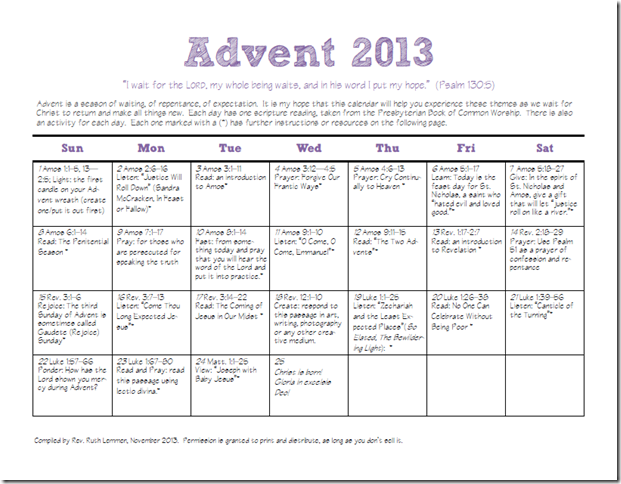
I enjoyed putting this together, and I’m looking forward to using it myself.  If you are looking for something to guide your reflection during Advent and help you engage the themes of Advent—and the God who came in the flesh and will come again—please feel free to use it, too.  It is available as a free printable.  You are free to print and distribute this, but I do ask that you don’t sell it—I’m making it available for free and would like to keep it that way.  Have a blessed Advent!  

November 24, 2013

Sunday Afternoon Prayer: Confession for Christ the King

This morning I was privileged to lead the confession and assurance during worship at Hamilton (MI) CRC.  I share here the words and prayer I led. 
9195944224_1bfedb8ba8_o

In the church year, today is Christ the King Sunday.  This is a Sunday to remember that Jesus is the King of kings and Lord of lords.  And it is a day to remember Christ must reign in our hearts, minds, and bodies.  But as we look at our hearts, minds, and bodies, we see how we have set ourselves up as king.  Let us confess that sin before God and each other. 

Gracious God,
You gave Jesus the highest name, that at the name of Jesus every knee should bow and tongue confess that Jesus is Lord.
But so often we refuse to bow.  We want to stand and be our own lords.
Our hearts are full of pride that thinks first of ourselves. 
We are selfish with our time, our abilities, and our money.
Lord have mercy.  Christ have mercy.

Our minds do not always acknowledge your kingdom.
We assume that we are right and everyone else is wrong. 
We use our minds to judge people who are different from us
Lord have mercy.  Christ have mercy.

We use our bodies for our own purposes instead your purposes.
We use our bodies to hurt other people and your good creation.
We also do harm to our bodies by not caring for them well.
Lord have mercy.  Christ have mercy.

In your great mercy and love, forgive us, Lord.  In the name of Jesus we pray.  Amen.

Even though we rebel against Jesus’ kingdom, God still loves us.  Hear these words: (Recited by two young boys from the congregation)
1 John 4:10-11
"This is love: not that we loved God, but that he loved us
and sent his Son as an atoning sacrifice for our sins.
Dear friends, since God so loved us, we also ought to love one another.”
People of God, know that you are forgiven and live at peace.


Photo by Jason Train.  Used under a Creative Commons License.


November 21, 2013

Imaginative Reading and Building A File

IMG_4690One of my favorite seminary classes was called Imaginative Reading for Creative Preaching, taught by then President Neal Plantinga and Professor Scott Hoezee.  I loved it because we read all kinds of wonderful books and talked about them with an eye to preaching.  We also had to collect quotes and observations from our reading as a start to a file.  I dreamed that as a pastor, I would be a voracious reader and my file would grow quickly.
But once I was a pastor, I didn’t read as much as I thought I would.  I was busy with meetings, answering e-mail, writing sermons, visiting people, and many more tasks.  One of my regrets about my first years of ministry is that I didn’t better protect time to read widely.  When I did read, I didn’t take the time to note those passages and themes I should save for later, so my file stayed about the same size.  On my list of things-I-want-to-do-better the next time I’m a pastor is read widely and be disciplined enough to add to the file. 

Perhaps you are wondering why it is important for me to read as a pastor.  Neal Plantinga has taken his thinking about this topic and discussions from classes and seminars he has led and crafted them into a new book called Reading for Preaching: The Preacher in Conversation with Storytellers, Biographers, Poets, and Journalists.  The premise of the book is that preachers should read widely because it helps us gain wisdom, improve our use of language, interact with new ideas and people, and find the best material for sermons. 

I studied English for my undergraduate education, and once I was in seminary I realized that all that reading and discussing and writing I did had taught me to do most of those things.  I had entered Tennyson’s grief at the death of a friend in his poem In Memoriam A.H.HI had grappled with stereotypes in Shakespeare’s Merchant of VeniceI experienced Hester Prynne’s guilt and shame in The Scarlet LetterAll of those experiences make me a better pastor, preacher, and person.
Reading brings me great joy—I love getting to know new people through a novel or seeing things in a new way from a poem.  Thankfully, Plantinga says to enjoy it.  “Good reading generates delight, and the preacher should enjoy it without guilt.  Delight is a part of God’s shalom and the preacher who enters the world of delight goes with God” (pg. x).  Plantinga’s blessing and exhortation in this book really encouraged me to be more intentional about reading and the less delightful (but important) process of recording some of my discoveries.   

At the same time, I have figured out some practical tips of what works for me which makes me much more motivated to do it.  First, the question of what to read.  My problem is usually having too many books to read at any particular time, but I often try to rotate through novels, non-fiction, and poetry.  Plantinga suggests “Just one novel a year?  And one biography?  And one-fifth of a book of poetry by one poet?  And a weekly visit to the website of Arts & Letters Daily to find out what the best journalists have been saying?  Not a bad plan, I think” (pg. 42).  Sounds doable, doesn’t it!  Plantinga offers a “Selected Reading List” at the back of his book to get started from.  Another way I like to select great books is from the Recommended Reading List for the upcoming Festival of Faith and Writing.   

When I am reading, if it is a paper book I have small sticky tabs that I place at the place on a page where I find something interesting.  Then, when I finish the book I go back through and if it still seems like something I want to save, I put it into the file.  (I picked up that tip from an interview Plantinga did for the release of his book.  Don’t ask how I had forgotten to ask him what his method is when I had the class with him.)  If I am reading on the Kindle app on my tablet, I highlight parts I want to save.  Then, when I am finished I go to my online Kindle account where you can see all of what you have highlighted.  Anything I want to save gets copied and pasted into my files.  Both of these methods have been working really well for me!

I keep my file in Evernote, which is a free software.  You can create multiple notebooks with various notes in each.  The best part is that I can tag each note with topics (love, grief, forgiveness, etc.).  Then when I am looking for something on a theme, I check out what I’ve tagged with it.  There is also a really convenient web clipper, which makes it really easy to save blog posts and online news clippings very easily.  Keeping my file in Evernote has been a key to actually using this system; I started out doing it differently and it was too much work.  (For the record, Evernote has no idea who I am, I just really like their software.)

I’m really looking forward to the day when I’ll be preaching regularly again and be able to use my file my often.  It is a great feeling to know that I am investing time now that should pay off in the future.  And now I’m off to Burma in a young adult novel I just started called Bamboo People

November 19, 2013

Wait. Hope. Expect. Playlist

Sometime this spring I was browsing through the stores in downtown Holland, MI.  At one, I found this little plaque.  The three words captured my season of life, so I bought it--partly as a reminder to hope and expect and not only wait.  It is currently hanging out on my dresser to keep reminding me that waiting comes to an end.

A few weeks ago, I was reading Who's Got Time: Spirituality for a Busy Generation.  I'll write more about it in the coming weeks, but it is chock full of interesting takes on spiritual disciplines--one of them is creating playlists.  I was inspired to make a playlist of songs that capture these three verbs.  I have been playing it ever since, giving words and feeling to the waiting, helping to have hope, and encouraging me to expect that God is working.  It starts with "From deep distress / and troubled thoughts / to you, O God / we raise our cries."  It journeys to "a mass grave / no one can raise.  / But you said "live" / and the ground it gives"  and to God "slipping out of underneath rocks / in alleys off the beaten path."  It ends with a benediction: "Christ be with me / Christ before me/ Christ behind me."  Wherever you are on your journey, may these songs bless you as they have blessed me.  If you have Spotify (its a free download), you can listen to most of the songs below.  The three that Spotify doesn't have I provided a link to in the list below.

1. "From Deep Distress," The Water and the Blood, Sojourn
2. "Wait," Meet Me At the Edge of the World, Over the Rhine
3. "Keep Breathing," Be Ok, Ingrid Michaelson
4.  "I'll Wait," Invisible Empires, Sara Groves
5.  "I Will Wait," Babel, Mumford and Sons
6.  "The Wait," Desire Like Dynamite, Sandra McCracken
7.  "A Far-Off Hope," Love & War & The Sea In Between, Josh Garrels
8. "All the Stars," The Blood and the Breath, Caroline Cobb
9. "Love's Redeeming Work is Done," Love Shall Be Our Token, High Street Hymns
10. "Dry Bones," The Blood and the Breath, Caroline Cobb
11. "I Hope You Dance," I Hope You Dance, LeeAnn Womack
12. "Holding On To Hope," Faint Not, Jenny & Tyler
13. "Zechariah and the Least Expected Places," The Bewildering Light, So Elated
14. "He's Always Been Faithful," The Collection, Sara Groves
15. "Refuge," Over the Grave, Sojourn
16. "Strangely Ready," The Collection, Sara Groves
17. "Abiding City," The Builder and the Architect, Sandra McCracken
18. "Christ Be With Me," The Brilliance, Brilliance


October 22, 2013

Autumn Adventures

I’ve been pretty silent on the blog, but I’ve been having plenty of adventures in these autumn months.

IMG_3383

Canning my mom’s famous salsa with four generations of my family (Grandpa, Mom, Cousin, Cousin’s son)

IMG_3472

I spent a few hours exploring ArtPrize in downtown Grand Rapids.  This was one of my favorite pieces, called Cascade.


IMG_2458

I headed west for a couple of weeks.  First, I spent time with my sister and brother-in-law in their new home in Colorado.

IMG_2472

Mary and I drove up to Independence Pass, about 40 miles of mountain driving from their house.

IMG_2587

It was peak color season for the Aspens and their vivid gold against the deep evergreens was spectacular.  For anyone wondering, late September or early October is an excellent time to visit—the weather and trees are beautiful and it is considered “shoulder season” so things aren’t so busy.

Mary is talented and made a video of our time together.  It features lots of footage of mountains, aspens, their canine companion, a gondola ride, and me awkwardly crossing a footbridge.  You can see it on her blog.

IMG_4058

Next stop: Laramie, Wyoming.  This was a new state for me, and it was like no other place I’ve been to.

IMG_4021

My reason for going to Wyoming: visiting my friend Allison, her husband, and infant son!  It was so good to see them!

IMG_4317

Back to Michigan: an impromptu lunch at Crane’s Pie Pantry with my mom—apple dumpling and apple cider…yum!

IMG_4323

An afternoon hike to Hoffmaster State Park

IMG_4337

Lake Michigan from Hoffmaster’s Dune Overlook

September 11, 2013

What I’m Listening To: Dry Bones

The album I’ve been listening to on repeat lately is called The Blood & The Breath: Songs That Sing the Story of Redemption by Caroline Cobb.  The songs trace God’s big story from Genesis to Revelation.  They thoughtfully bring scripture to life—even some texts that aren’t often sung.  My favorite song is called “Dry Bones,” based on Ezekiel 37.  I don’t know many songs based on this strange passage (or Ezekiel in general), but this song has helped me see the beauty of life coming from dry bones.  And it gives me hope that situations that seem dry and hopeless can be revived by the Spirit of God.  The words are good, but to get the full effect you should go to Caroline’s website, listen to the song, and download the album.
6885885149_5b809af6a1_oDry bones
Hearts of stone
Slain and left
In the valley of death

Been dead so long
All the flesh is gone
A mass grave
No one can raise


But you said “live”
And the ground it gives
The bones start to rattle
And the darkness lifts


You give them blood and bone and
Hearts of stone to flesh
You give them muscle, skin
And life within the breath


Open graves
Bodies raised
The living breath
Reversing death


Written May 2011 for The Scripture to Music Project
Words and music by Caroline Cobb
From Ezekiel’s vision in Ezekiel 37:1-14; 36:26,27

Photo by _ChrisUK, used under a Creative Commons License.

September 02, 2013

Saugatuck Dunes Hike


To celebrate Labor Day, I took a hike I’ve been meaning to take all summer.  I grew up going to the beach at Saugatuck Dunes State Park, but I had never really hiked there.  My trusty Best Easy Day Hikes: Grand Rapids, MI told me that there is good hiking, too.  So this morning I packed a lunch and set out.  I took the South Trail, which the book says is 4.8 miles and the state park map lists as 5.5 miles.
IMG_3084
The trail on the way to Lake Michigan was mostly through deciduous forests on a sandy, but firm, trail.
IMG_3096
Shortly before Lake Michigan, the trail passed through the foredunes.
IMG_3103
Almost to the beach!
IMG_3128
On the beach, looking north.  You can’t make it out in the picture, but I could see Big Red (the Holland lighthouse) in the distance.  After snacking on the beach, I started out on the return trail, which travels through the foredunes and then zig zags up through blown out dunes.  This part of the trail was harder than the first part!  But looking back at the lake, the views were beautiful.
IMG_3150
IMG_3167

This is now one of my favorite dune hikes in Michigan!  It has a more natural and remote feel than a lot of the parks (no stairs, for instance) and the dunes are extensive.  I’d highly recommend it to anyone who wants to explore the dunes and is ready to climb through a lot of sand.

August 30, 2013

Goodbye, Grand Rapids


Tonight is the last night I will sleep in my apartment in Grand Rapids.  For the foreseeable future, it is the last night I will stay in GR as a resident, and not someone’s guest.  This is a sad night for me.  This is the place I became an adult.  I have lived here for 3/4 of my adult life.  I went to Calvin College here.  I went to Calvin Theological Seminary here.  I had my first call at Church of the Servant here.  Living in Grand Rapids has shaped me in so many ways. 
People love to hate Grand Rapids; some call it “bland rapids.”  It is not as big or as cosmopolitan as New York or Chicago.  But Grand Rapids has its own charm.  There are lots of wonderful places and things to do in Grand Rapids.  Let me share a few of my favorites with you:
And of course, the people are such an important part of Grand Rapids and my experience here.  Professors and friends from Calvin College.  Professors, staff, and students at Calvin Seminary, where I was enfolded into community.  Other wonderful friends that I made during my seminary days.  Colleagues and congregants at Church of the Servant.  I wouldn’t be who I am without all of you all.
I don’t know where I am going to land in the future, but I am thankful for the ways Grand Rapids has shaped me, and I am excited to take that with me to my unknown destination.  Thanks, Grand Rapids.  Its been great!  

August 18, 2013

Sunday Afternoon Prayer: Great is Thy Faithfulness

IMG_5535This weekend my family is celebrating my maternal grandfather’s 90th birthday.  My grandpa has been following Jesus for his whole life and would be the first to say that God has been faithful.  Life has not been without challenges, but God has been with Grandpa and used him to bless many people.

Loving and Faithful God,
For keeping a child of your covenant, baptized when he was an infant, safe in your hands,
Great is thy faithfulness.
For his parents who loved him and taught him about you,
Great is thy faithfulness.
For keeping Grandpa safe while he was deployed in the Navy,
Great is thy faithfulness.
For giving him a beautiful wife who loved him until her dying day,
Great is thy faithfulness.
For three children that he loved and supported (and is still very willing to help weed gardens or repair their homes),
Great is thy faithfulness.
For helping him to become a great teacher and principal,
Great is thy faithfulness.
For blessing him with grandchildren—both adopted and biological—that he loves deeply,
Great is thy faithfulness.
For saving his life from cancer,
Great is thy faithfulness.
For Grandpa and Grandma’s consistency at showing up at their grandkids events—church programs, piano recitals, sports games, etc.,
Great is thy faithfulness.
For the hours of volunteer service at Desert Christian High School, World Renew (formerly CRWRC) Disaster Response Services, Bibles for Mexico Thrift Stores, and other places,
Great is thy faithfulness.
For the love he shows his great-grandchildren through creating toys and babysitting,
Great is thy faithfulness.
For the love of and commitment to the church (there are few times I’ve heard him complain about it!) that he demonstrates to all of us,
Great is thy faithfulness.
For 90 years of following you,
Great is thy faithfulness.
Great is thy faithfulness! Great is thy faithfulness!
Morning by morning new mercies I see;
all I have needed thy hand hath provided.
Great is thy faithfulness, Lord, unto me!


Personal photo of my grandpa and me at my ordination, January 2012.

August 15, 2013

On My New Found Love of Poetry

When I was in seminary, I heard Eugene Peterson speak at the Festival of Faith and Writing.  He was asked what advice he would give to young pastors.  I think he had three pieces of advice, but I only remember two.  Those two have stuck with me, though: learn Biblical languages really well and pick a few poets to read deeply.  I inwardly groaned at the first and was intrigued by the second.  Peterson said that as people who use language extensively, pastors should read poetry to increase your grasp of how English works.  Poets are the people who play with language—vocabulary choices, rhythm, stress, imagery, metaphor, punctuation.  He suggested picking 3-4 poets who you read regularly and get to know well.  I haven’t been as intentional as he about sticking with certain poets, but I have found myself reading poetry more in the last two years of my life than any time before.
    
Before this point in my life I have not been a huge poetry fan.  I didn’t actively dislike it, but with few exceptions I didn’t love it, either.  I am not the best poetry reader and I’m a worse poetry writer.  I did read enough poetry when I was an English major to get a sense of styles I am drawn to and those I’m not (lets just say that T.S. Eliot will never be one of the 3-4 poets I dwell one).
poetry books
So why did I start reading more poetry once I became a pastor?  I don’t think it was just because Eugene Peterson said I should or the inner English major who always wished I was better with poetry.  In the “Author Q & A” of Lauren Winner’s Still: Notes on a Mid-life Faith Crisis she talks about why she reads and writes about poetry.  Winner bases her answer on an observation by Richard Rohr that our spiritual lives have two halves—the season where you build a spiritual identity and the season where you face crisis and come to know God in a deeper way.  “Rohr says that in the second half of your spiritual life you may find yourself reading a lot of poetry.  Maybe, before, you read dogmatics or self-help how-tos or narrative history.  Before, poetry may have seemed elusive and loopy.  In the second of Rohr’s two halves, you like the space that poetry offers” (pg. 205-206). 

In the messiness of being a pastor, I like that space poetry offers.  Every day I face questions and ambiguities about faith and life.  There are the questions that inevitably come with reading scripture.  There are difficult situations in people’s lives that pastors are called to walk through with them.  There are specific applications of how we love our neighborhood, like do we help this person with their rent?  And who am I in all of this; what does it mean to be a pastor? 

In the messiness, poetry gives space.  Space to be.  Space to live with the ambiguity.  Space to question and wonder and enjoy something beautiful.  In her book about being good stewards of language, Caring for Words in a Culture of Lies, Marilyn Chandler McEntyre says, “poetry can teach us specific skills that we need now more than ever to cultivate if we are to retain a capacity for subtlety” (pg. 159). 
Good poetry doesn’t try to give all the answers and tie everything up into neat bows.  It isn’t full of platitudes.  I appreciate that because it is honest and authentic.  That's the kind of person I want to be, too—someone who can hold up to the pressure of the ambiguities in my own life and others lives.  I don’t think that it is a coincidence that one of my favorite books of the Bible is Psalms, a book full of poems.  In the psalms I find that same sort of honesty and authenticity as in other poetry.  The psalmist doesn’t usually sugarcoat things.  If he (or possibly she) is angry at God or feels wronged by God, he says so directly.  The psalms don’t always wrap everything up neatly, although they almost always end with a statement of trust in God.  The psalms, and other poems, give space to live with the ambiguity that comes from living in a broken world.  Poems can also point us towards  the hope that we have in Christ, that things are ultimately secure, even if they appear to be falling apart

I’m going to keep reading poetry, to keep finding that space and keep honing my skill with language.  I’ll keep sharing some of my favorite poems here, as I’ve done in the past.  The poets I have read the most in the past couple of years (in addition to the Psalms) are Scott Cairns, Mary Oliver, Robert Frost, and Luci Shaw.  The Poetry of Robert Frost is on my bed stand right now, so perhaps he’ll show up here next. 

Photo by Liesbeth den Toom, used under a Creative Commons License.

August 13, 2013

Post at Fidelia’s Sisters (and other ways to read my posts)

1. Today you can read my writing at Fidelia’s Sisters, a publication of The Young Clergywomen Project, about learning to camp alone.  I remember finding this website while I was still in China but planning to start seminary a few months later.  I was searching the internet for information about clergywomen, because my personal experiences with them were few and far between.  That was within TYCWP’s first year and I was thankful to find out "I’m not the only one” through Fidelia’s Sisters.  Now that I’m ordained, I’m a member of the group and I have learned a lot from interacting with young clergywomen from many traditions—I don’t always agree with everything—but the breadth of Christian tradition has been a blessing.  I’m excited to have my writing join the story there!  And welcome if you have come over from there!
IMG_06422. Lots of you follow this blog via my links on Facebook.  If you want to be sure to not miss any posts (either because I forget to post the link or because it is possible to miss things on Facebook), you can subscribe via e-mail and you’ll get an e-mail when new posts go up.  Find the “Follow by E-mail” box in the right-hand column and enter your e-mail in that box.  Or, if you follow lots of blogs you can use a blog reader, which collects all the new posts of blogs you read in one place.  I use Feedly, but have also heard good things about Bloglovin’.  I am a recent convert to using a reader, and can’t believe I waited so long—it makes it so easy!  Thanks for reading!

Personal photo of camping at Ionia State Recreation Area, September 2012. 

August 11, 2013

Sunday Afternoon Prayer: He Didn’t Know Where He Was Going


6532913915_266451fbe9_o


“By faith Abraham, when called to go to a place he would later receive as his inheritance, obeyed and went, even though he did not know where he was going.  By faith he made his home in the promised land like a stranger in a foreign country; he lived in tents, as did Isaac and Jacob, who were heirs with him of the same promise.  For he was looking forward to the city with foundations, whose architect and builder is God.  And by faith even Sarah, who was past childbearing age, was enabled to bear children because she considered him faithful who had made the promise.  And so from this one man, and he as good as dead, came descendants as numerous as the stars in the sky and as countless as the sand on the seashore” (Hebrews 11:8-12).


God of Abraham,

You called Abraham to a place, but you didn’t tell him where it was.

You asked him to make a leap of faith, to trust that you were faithful and had a plan.

You made crazy promises (descendants to an infertile couple?) to Abraham,

and you kept your promises.


Promise-keeping God,

I’m really holding on to the fact that you are faithful, because things look pretty confusing right now.

I’m trusting that you have called me to a place, but haven’t told me where it is yet.

I’m packing my boxes, trying to figure out what I’ll need if the waiting lasts 2 months, and what I’ll need if its 4 more months, or 6 months,

trusting that you have a plan for all of this.


Faithful God,

Give me the faith of Abraham, the faith to trust you to guide me to a place,

Give me the trust of Abraham to make my home in a temporary place,

Give me the patience to wait to see how you’ll work,

because I “consider him faithful who had made the promise.”

Amen.


Photo by Joana Bourne, used under a Creative Commons License.

August 04, 2013

Sunday Afternoon Prayer: We Are Your Children

Today’s prayer also comes from An African Prayer BookIt is a prayer from our brothers and sisters of the the Anglican Church of the Province of Southern Africa.  It is a wide-ranging prayer that covers many topics, and I am going to use an adapted version of it in a worship service I am leading tonight.  I am looking forward to leading Christian Reformed folks in Michigan in prayer using words from the Anglican Church in Africa.
63206513_f0f54fdc76_oFather, we are your children, your Spirit lives in us and we are in your Spirit: hear us, for it is your Spirit who speaks through us as we pray.
Lord hear us.
Father, you created the heavens and the earth: bless the produce of our land and the works of our hands.
Lord hear us.
Father, you created us in your own image: teach us to honor you in all your children.
Lord hear us.
Father, in your steadfast love you provide for your creation: grant good rains for our crops.
Lord hear us.
Father, you inspired the prophets of old: grant that your Church may faithfully proclaim your truth to the world.
Lord hear us.
Father, you sent your Son into the world: reveal him to others through his life in us.
Lord hear us.
Lord Jesus, you sent your apostles to make disciples of all nations: bless the bishops of this province, especially N our bishop, together with N our metropolitan, and all ministers of your Church.
Christ hear us.
Lord Jesus, for your sake men and women forsook all and followed you: call many to serve you in religious communities and in the ordained ministry of your Church.
Christ hear us.
Lord Jesus, you called your disciples to take up the cross: deepen in us a sense of vocation.
Christ hear us.
You prayed for your Church to be one: unite all Christians that the world may believe.
Christ hear us.
You forgave the thief on the cross: bring us all to penitence and reconciliation.
Christ hear us.
You broke down the walls that divide us: bring the people of this world to live in peace and concord.
Christ hear us.
You taught us through Paul, your apostle, to pray for kings and rulers: bless and guide all who are in authority.
Christ hear us.
You were rich yet for our sake became poor: move those who have wealth to share generously with those who are poor.
Christ hear us.
You sat among the learned, listening and asking them questions: inspire all who teach and all who learn.
Christ hear us.
You cured by your healing touch and word: heal the sick and bless those who minister to them.
Christ hear us.
You were unjustly condemned by Pontius Pilate: strengthen our brothers and sisters who are suffering injustice and persecution.
Christ hear us.
You lived as an exile in Egypt: protect and comfort all refugees.
Christ hear us.
You knew the love and care of an earthly home: be with migrant workers and protect their families.
Christ hear us.
You open and none can shut: open the gates of your kingdom to those who have died without hearing your gospel.
Christ hear us.
You have been glorified in the lives of innumerable saints: give us strength through their prayers to follow in their footsteps.
Christ hear us.
Father we know that you are good and that you hear those who call upon you: give to us and to all people what is best for us, that we may glorify you through your Son, Jesus Christ our Lord, who is alive and reigns with you and the Holy Spirit, one God, now and forever.
Amen.


From “An Anglican Prayer Book 1989, Church of the Province of Southern Africa” in An African Prayer Book, Selected and with Introductions by Desmond Tutu, Image/Doubleday New York, 1995.
 
Photo of an Anglican pastor in Liongwe, Malawi by khym54, used under a Creative Commons License.

August 01, 2013

Everything That Rises Must Converge

Two years ago this week, I started working at Church of the Servant.  I had just graduated from seminary a few months earlier and it was my first pastoral call.  I was nervous.  I wasn’t completely sure I would actually like being a pastor full-time.  And I wasn’t exactly sure what it meant that I was now a pastor.

Throughout seminary, I felt torn.  Before I went to seminary I taught English in China.  That had been an interest of mine since I was in high school.  I went to college with that in mind.  I was an English major and Chinese minor.  And I loved teaching English.  If I had chosen my life’s path I would have gotten an MA in TESOL (teaching English to Speakers of Other Languages).  Instead, God called me to seminary, to the world to theology, Biblical languages and studies, church history, and pastoral care.  And there were lots of moments that I felt lost and out of place.  I would hear people talking outside of class and have no idea who or what they were talking about.  I grew to enjoy seminary and had wonderful internships.  But I still felt like I had two parts.  I had the English teacher part of me and the pastor/seminarian part of me.  And they didn’t go together.

Then I started at COS where I became the primary pastor for the Basic English Service.  As I prepared sermons, I needed the skills I learned teaching English of explaining abstract or difficult concepts with simple words.  I needed the skills I learned in seminary of how to read a Biblical text well and understand what it is saying.  I needed the skill of speaking slowly naturally and articulating words carefully.  I needed the systematic theology I learned to help explain what Christians believe.  I needed all of the cross-cultural skills that I had developed.  I needed to know how to structure a sermon effectively. 
  
In this call, the English teacher part of me and the pastor part of me started to come together.  The threads of my life started to get pulled together into one strand instead of being separate.  My spiritual director shared a phrase with me, the title of a Flannery O’Connor short story, “everything that rises must converge.”  This has been true for me in the last two years.  Everything that had risen in my life converged, and I am so grateful.
320461_10152097141755012_336543183_nI am grateful for the opportunity to preach in this unusual environment and the ways that it has shaped my preaching.  Preaching regularly to a community has helped me form a rhythm of sermon preparation and become comfortable with preaching.  It is still always a little nerve-wracking somewhere in the process, but it also feels like this is what I do, because I am a pastor now.  And preaching in this unique service helped me to hone in on being clear and having one point in mind.  It helped me to think through what is most important in the given passage and leave lots of interesting but not essential information in the study.  It was a privilege to preach to many people that were hearing the story of the Bible for the first time, and I hope that I keep that in mind even if I am in a church where they are a lower percentage of the congregation.

I am grateful for the opportunity to work with the wonderful staff at COS.  They respected me as a colleague, encouraged me when things were difficult, modeled practices of Christian ministry, and loved me.  I learned a lot from spending time with them in the church kitchen and work room, listening in to conversations about the budget, handling pastoral situations, and picking curriculum for kids.  The high rate of turnover with residents is hard for the staff because they get attached to us and then two years are over and we leave, so I am especially thankful that they took the time to get to know me and allow me to learn so much.
IMG_2532I am grateful for the many cups of chai (both Nepalese and Sri Lankan versions) I drank in people’s homes.  I was welcomed into people’s homes with such gracious hospitality.  I don’t think I was ever told I couldn’t come, and it was a rare day when I wasn’t offered chai, or juice, or fruit.  Americans (and I am not an exception) are not that good at being hospitable to strangers.  I hope that I will be able to share some of the hospitality I received with others.  It was a privilege to be welcomed in to homes, to hear the stories of people in my congregation (most of whom were refugees), and walk alongside them in life.  I am thankful for their love and their prayers.
 
I am grateful for the strong volunteer base at COS.  Every program I worked with had strong volunteer leaders—people who dedicate hours of their time and energy to serving the church and community.  I’ll admit, sometimes this was frustrating and sometimes those leaders were frustrated with me.  But I am thankful for the relationships that formed and that we ended on a good note.  I feel at peace that even relationships that were sometimes tense ended well, and I am so thankful. 
IMG_2608
I am grateful that many of my experiences, gifts, and interests have risen in my life and converged together in becoming a pastor.  In these two years, I became a pastor in an important way.  I am not wondering if I can do it anymore.  I am not trying to imagine how I would face pastoral situations the way I was two years ago.  Although my time being a pastor at COS has come to an end, and I don’t know where I will be called next, I am a pastor now.  I look forward to the (yet-to-be-determined) day when I start my next call, when I can take all I learned at COS and be a pastor in a new congregation. 

Everything that rises has converged.  Thanks be to God!   

July 28, 2013

Sunday Afternoon Prayers: For a Bittersweet Day

Today is bittersweet.  It was my last Sunday morning with my congregation.  I am so thankful for these two years, and it is so hard to say goodbye.  And so today I offer two prayers.  Both of these prayers originate in Africa and came to me in An African Prayer Book.


My prayer of thanksgiving, for the people I have had the opportunity to know from around the world and for the ways that they have shown that church can be like a big family.

Our Churches Are Like Big Families

Lord, we thank you that our churches are like big families.
Lord, let your spirit of reconciliation blow over all the earth.
Let Christians live in your love.
Lord, we praise you in Europe's cathedrals, in America's offerings, 
And in our African songs of praise.
Lord, we thank you that we have brothers and sisters in all the world.
Be with them that make peace.
Amen. (West Africa, pg. 65-66).

And my prayer for the people that I am leaving, that God will continue to be at work in and through them and will continue to hold them in the palm of his hand.

The Privilege Is Ours To Share In the Loving

Almighty God, our heavenly Father, the privilege is ours to share in the loving, healing, reconciling mission of your Son Jesus Christ, our Lord, in this age and wherever we are.  Since without you we can do no good thing.
     May your Spirit make us wise;
     May your Spirit guide us;
     May your Spirit renew us;
     May your Spirit strengthen us;
So that we will be:
     Strong in faith,
     Discerning in proclamation,
     Courageous in witness,
     Persistent in good deeds.
This we ask through the name of the Father.
(Church of the Province of the West Indies, pg. 96-97)


Prayers from An African Prayerbook, selected and with an introduction by Desmond Tutu, Image/Doubleday books, 1995.
Photo by John Flanigan, http://www.flickr.com/photos/82369865@N00/5414528258/in/photolist-9fsSBu, used under a Creative Commons License